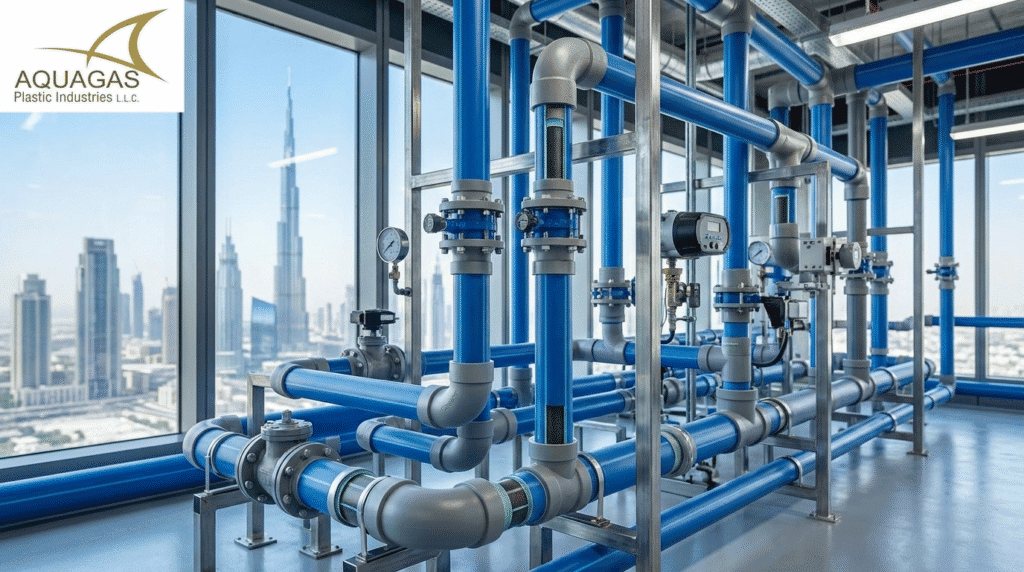
Nairobi’s skyline is undergoing a dramatic structural transformation. Vertical urbanization across areas like Kilimani, Westlands, Upper Hill, and Kileleshwa has pushed architectural designs past fifteen stories, with many premium residential towers and commercial hubs reaching twenty to thirty floors. While these skyscrapers maximize space and offer premium panoramic views, they introduce severe physical challenges to internal mechanical networks. Meeting these demands requires piping systems built by manufacturers with a genuine presence in the region, which is why MEP consultants across Kenya’s high-rise sector increasingly specify certified polymer networks rather than legacy metal alternatives.
Among these challenges, high-rise water distribution systems operate under unique and demanding hydraulic conditions. As vertical infrastructure scales upward, the weight of the water column creates massive hydrostatic head pressures within the main riser lines. Managing this intense force over a multi-decade operational lifespan requires a major shift away from traditional galvanized iron and standard polypropylene materials.
Advanced structural developments specify Polypropylene Random Crystallinity Temperature (PP-RCT) piping systems as the modern standard. PP-RCT represents the next generation of polymer engineering, designed to withstand extreme hydrostatic stresses while offering value engineering advantages to developers throughout East Africa. Global manufacturers such as Aquagas Plastics have built dedicated production capacity to serve exactly this kind of demanding vertical infrastructure.
1. The Physics of Hydrostatic Head in Nairobi’s Tall Structures
To distribute water effectively across a high-rise building, engineers must design vertical riser systems that pull water from underground borehole holding tanks, pass it through high-capacity booster pumps, and lift it to upper levels or rooftop reservoir systems. The fundamental design challenge in this layout is gravity.
Calculating the Hydrostatic Column Stress
A column of water exerts physical pressure downward due to gravity, a metric defined as hydrostatic head. For every 10 meters of vertical rise, the fluid column generates roughly 1 bar (100 kPa) of static pressure.
In a twenty-story residential development standing approximately 70 meters tall, the water column creates a continuous static pressure of roughly 7 bars at the base of the main riser line. When you add the dynamic operating pressure needed to push water through upper-floor fixtures, the sustained pressure inside the lower-level plumbing lines can easily reach 10 to 12 bars. Standard pipe joints and lower-tier polymers struggle to handle this level of constant physical stress without swelling or bursting over time.
The Problem with Structural Expansion and Contraction
High-rise riser networks do not just face high internal pressures; they must also navigate physical movement. In Nairobi, where ambient daily temperatures fluctuate and hot water recirculation loops run constantly for domestic use, lines expand and contract.
When a standard polymer pipe expands under hot water conditions, it grows longer. If a vertical riser is constrained within a concrete utility duct across twenty floors, this linear thermal expansion causes the line to bow, twist, or push hard against structural fixed brackets. This constant movement puts immense physical stress on welded connections, leading to sudden mechanical failures inside building shafts. Engineers evaluating Kenya’s borehole-fed systems have flagged similar structural risks when pipe material is mismatched to local water conditions, a concern examined in more detail in this piece on fluoride, hardness, and borehole water chemistry in Kenya.
2. The Material Science of PP-RCT: Why Crystalline Structure Matters
Standard Polypropylene Random Copolymer (PPR) has served as a reliable plumbing standard for low-to-medium-rise applications for decades. Reliable PPR pipes remain the right specification for mid-rise residential and commercial buildings across the region. However, high-rise structures push standard PPR to its physical boundaries. To meet these higher demands, material science developed PP-RCT.
The core innovation of PP-RCT lies in its specialized manufacturing process, which alters the crystallization matrix of the polymer. Standard PPR cures with a random distribution of large alpha crystals, a configuration that results in thicker walls being required to handle higher pressures, which increases the overall dead-weight load on building frameworks.
PP-RCT pipes utilize advanced nucleating agents during extrusion to create a dense, highly uniform arrangement of micro-fine beta crystals. This structural refinement changes the mechanical capabilities of the pipe substrate, providing exceptional hydrostatic strength at elevated temperatures. Because the polymer compound is structurally stronger on a molecular level, a PP-RCT pipe can handle identical or higher pressure ratings than standard PPR while utilizing a significantly thinner pipe wall profile. This shift from thick-walled polymer structures to thin-walled, high-strength layouts provides major technical benefits for high-rise riser designs.To leverage this crystalline reinforcement against extreme hydrostatic head pressures, consultants can To leverage this crystalline reinforcement against extreme hydrostatic head pressures, consultants can Specify Advanced PP-RCT Piping Systems built for high-tier vertical infrastructure.
3. Engineering Advantages of PP-RCT in Vertical Riser Layouts
Transitioning from traditional materials to a certified PP-RCT network provides distinct advantages for MEP contractors and structural engineers working on Nairobi’s high-density developments.
Expanded Hydraulic Flow and Reduced Friction Loss
Because PP-RCT features thinner structural walls while maintaining heavy-duty pressure ratings, its internal cross-sectional area expands significantly. For example, comparing a standard PPR pipe to a PP-RCT pipe of the same outer diameter reveals that the PP-RCT option provides a much larger internal opening.
This expanded space allows a higher volume of water to flow through the line at a lower velocity. A larger internal diameter minimizes hydraulic friction losses, allowing water to glide smoothly along the mirror-smooth internal matrix with a roughness factor of just 0.007 mm. This smooth profile means municipal or borehole booster pumps pull fewer kilowatts to move water to top floors, directly cutting monthly energy costs for the building’s estate management.
Downsizing Pipe Diameters without Sacrificing Flow
The increased hydraulic efficiency of PP-RCT allows engineering teams to implement value engineering by downsizing line sizes across the vertical grid. Where a design would typically require a thick-walled 110mm standard PPR pipe to safely handle a high-pressure zone, a 90mm or even 75mm PP-RCT line can often deliver the same fluid volume at the required pressure class. Downsizing the dimensions cuts total material procurement costs and permits the use of smaller, space-saving utility shafts across every floor plan. Matching this with compatible PPR fittings at every joint, elbow, and branch point ensures the entire riser network, not just the straight pipe runs, is rated for the same pressure class.
Eliminating Structural Dead Weight
Traditional high-pressure riser systems often relied on heavy carbon steel or iron pipes. Shifting to lightweight PP-RCT systems drastically reduces the dead-weight structural load resting on a skyscraper’s concrete columns and floor slabs. Furthermore, lightweight lines eliminate the need for heavy site cranes, allowing mechanical crews to lift, position, and weld long vertical runs manually and safely. Precision-manufactured fittings that match the pipe’s dimensional tolerances also make it far easier for site crews to maintain consistent fusion quality across dozens of floors.
4. Addressing Temperature Demands: Glass-Fiber Reinforced PP-RCT
For high-rise residential properties utilizing centralized solar hot water distribution networks, which are common across Nairobi due to energy-conservation mandates, riser lines must handle high internal fluid temperatures. Under continuous exposure to hot water (60°C to 70°C) at high pressures, standard unreinforced plastics weaken and expand excessively. This exact challenge is why reliable pipe selection has become critical for solar water heating installations that depend on consistent hot-water performance, a lesson that applies equally to Nairobi’s centralized systems.
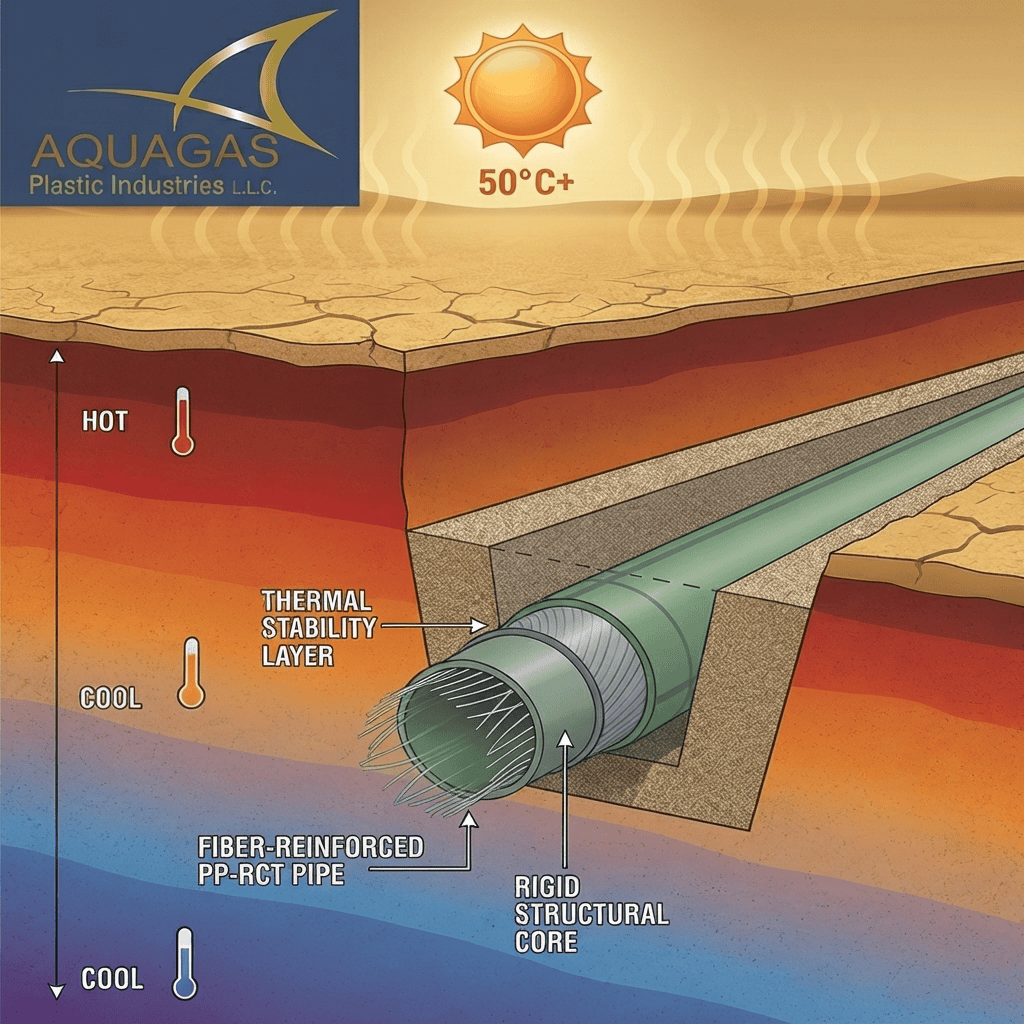
To resolve this issue, premium systems utilize multi-layer co-extruded PP-RCT pipes reinforced with a structural glass-fiber composite middle core, such as the fiber-reinforced pipe range under the AquaTerra brand. This middle layer alters how the pipe behaves when heated by reducing the linear thermal expansion coefficient by up to 75% compared to standard unreinforced polymers. This keeps the pipe stable and maintains its straight alignment inside the structural shafts, eliminating heavy bowing and reducing the need for expensive, complex expansion loops and sliding brackets, saving valuable field installation time. For projects that call for a standard-duty PPR line alongside the reinforced riser network, the PP Terra range covers general-purpose distribution branches at a lower specification tier.
5. Specification Compliance and Investment Verification
For real estate developers, financial auditors, and principal project specifiers in East Africa, selecting plumbing components must center on long-term structural reliability. The table below details the performance metrics that distinguish PP-RCT from legacy plumbing solutions:
| Performance Criterion | Traditional Steel / Iron Piping | Advanced PP-RCT Piping Systems |
| Material Longevity | 10–15 Years (highly vulnerable to borehole rust) | 50+ Years (immune to chemical and mineral attack) |
| Wall Profile Thickness | Heavy, restrictive cross-section | Thinner walls with maximized internal flow area |
| Scaling and Clogging | High risk of mineral scale choking flow | Zero scale accumulation due to ultra-smooth substrate |
| Joint Performance | Threaded links prone to oxidation leaks | Homogeneous fusion weld creating a single solid line |
| Structural Impact | Massive dead-weight load on building frame | Extremely lightweight; fast, safe site handling |
To satisfy National Construction Authority (NCA) guidelines and clear international building insurance requirements, all high-rise specifications should demand verification of compliance with premium European standards, including DIN 8077/8078 and EN ISO 15874. Developers pursuing government or institutional contracts should also review how these standards translate into actual tender requirements, as outlined in this breakdown of specifying PPRCT for government tenders and procurement compliance.
Frequently Asked Questions (FAQs)
- What is hydrostatic head, and how does it affect water distribution lines in Nairobi’s skyscrapers?
Hydrostatic head is the physical pressure exerted downward by a column of water due to gravity, generating roughly 1 bar (100 kPa) of static pressure for every 10 meters of vertical rise. In a 70-meter-tall, twenty-story development, the fluid column creates a continuous static pressure of approximately 7 bars at the base of the main riser line. When combined with the dynamic operating pressure required to push water through upper-floor fixtures, sustained internal pressures can reach 10 to 12 bars, causing lower-tier polymers to swell or burst over time. - How does linear thermal expansion impact vertical riser lines within concrete utility ducts?
When a standard polymer pipe expands under hot water conditions, it grows longer. If a vertical riser is constrained within a concrete utility duct across multiple floors, this linear thermal expansion causes the line to bow, twist, or push hard against structural fixed brackets. This continuous physical movement puts immense stress on welded connections, leading to sudden mechanical failures inside the building shafts. - What is the core molecular innovation that distinguishes PP-RCT from standard PPR?
Standard PPR cures with a random distribution of large alpha crystals, requiring thicker walls to handle higher pressures. The core innovation of PP-RCT lies in its specialized manufacturing process, which utilizes advanced nucleating agents during extrusion to create a dense, highly uniform arrangement of micro-fine beta crystals. This molecular refinement provides exceptional hydrostatic strength at elevated temperatures, allowing the pipe to handle identical or higher pressure ratings using a significantly thinner wall profile. - How does the thinner wall profile of PP-RCT lower operational energy costs and permit value engineering?
Because PP-RCT features thinner structural walls, its internal cross-sectional area expands, allowing a higher volume of water to flow at a lower velocity. This minimizes hydraulic friction losses along the mirror-smooth internal matrix (k = 0.007 mm), meaning booster pumps pull fewer kilowatts to move water, directly cutting monthly energy costs. Furthermore, this increased efficiency allows engineering teams to downsize line sizes (e.g., replacing a 110mm standard PPR pipe with a 90mm or 75mm PP-RCT line), cutting procurement costs and saving space in utility shafts. - Why are glass-fiber reinforced multi-layer PP-RCT pipes recommended for centralized solar hot water networks?
Under continuous exposure to high-pressure hot water (60°C to 70°C), standard unreinforced plastics weaken and expand excessively. Premium systems utilize multi-layer co-extruded PP-RCT pipes reinforced with a structural glass-fiber composite middle core. This middle layer alters thermal behavior by reducing the linear thermal expansion coefficient by up to 75% compared to unreinforced polymers, keeping the pipe straight, eliminating heavy bowing, and reducing the need for complex expansion loops. - What long-term structural and performance advantages does PP-RCT offer over traditional steel or iron piping?
Traditional carbon steel or iron pipes have a short material longevity of 10–15 years due to vulnerability to borehole rust, add massive dead weight to the building frame, and pose a high risk of mineral scale choking the flow. Advanced PP-RCT systems offer a stable asset lifecycle of 50+ years, are completely immune to chemical and mineral attack, maintain zero scale accumulation, and utilize homogeneous fusion welds to create a single leak-proof solid line. Their lightweight composition also drastically reduces structural dead-weight and eliminates the need for heavy site cranes.
Conclusion: Securing Long-Term Value in Vertical Construction
As Nairobi continues to expand vertically, the durability of its hidden utility infrastructure dictates the financial and physical security of its real estate assets. Designing high-rise water networks with materials vulnerable to internal rust, high weight limits, or wall-thinning blowout faults under pressure is no longer a viable option for forward-thinking developers.
Specifying advanced PP-RCT piping systems allows MEP consultants to design high-pressure vertical riser grids with complete confidence. By utilizing the molecular strength of dense beta-crystalline structures, PP-RCT delivers thinner walls, expanded flow profiles, reduced pump energy consumption, and high structural resilience. Investing in high-performance polymer engineering protects high-rise assets, avoids costly water damage repairs, and ensures Nairobi’s vertical developments remain functional for a 50-year maintenance-free operational life. Developers and contractors sourcing certified PPR pipe and fitting ranges for Kenyan projects can review the complete product line on the Aquagas Plastics Kenya product portal, or explore the full manufacturer catalogue at aquagasplastics.com.
To explore professional assembly methodologies, correct welding timing patterns, and the specific field tooling needed to secure homogeneous fusion bonds across high-pressure networks, watch the comprehensive PP-RCT High-Rise Field Installation Guide.