The UAE’s luxury hospitality sector, iconic high-rise residential towers, and massive commercial developments operate under some of the most stringent mechanical engineering standards in the world. As developers across Dubai and Abu Dhabi push the boundaries of structural scale, the internal mechanical, electrical, and plumbing (MEP) systems driving these structures must evolve at a matching pace. Among these systems, the centralized domestic hot water (DHW) loop is one of the most critical and physically demanding networks in any modern UAE market mega-project.
To comply with public health mandates and ensure safety against biological hazards like Legionella bacteria, UAE commercial buildings maintain constant hot water circulation loops. These systems run continuously at temperatures ranging between 60°C and 70°C, the range at which Legionella bacteria cannot survive.
For traditional thermoplastic piping networks, this unrelenting thermal load presents a massive structural challenge: linear thermal expansion. Under constant heat, standard PPR pipes expand rapidly, leading to pipe sagging, severe stress concentration at fixed anchor points, and eventual fatigue failure at joint connections.
To protect high-value infrastructure and eliminate premature MEP system failures, tier-1 consultants and contractors are moving away from legacy plastics. Instead, they are specifying advanced Glass-Fiber Reinforced Polypropylene Random Crystallinity Temperature (PP-RCT) multi-layer composite piping systems.
1. The High-Temperature Reality of UAE Centralized Hot Water Networks
In large-scale hospitality projects, luxury resorts, and high-density residential blocks across the UAE, centralized hot water systems cannot afford performance drops. These systems utilize extensive loop layouts where water is continuously heated and pumped through vertical risers and horizontal distribution rings, ensuring instant hot water at every tap, regardless of the floor height.
The Thermal Expansion Problem
The core issue stems from basic thermodynamics. Thermoplastic materials possess a high coefficient of linear thermal expansion. When standard, unreinforced Polypropylene Random Copolymer (PPR) pipes are subjected to a temperature differential (ΔT) of 40°C to 50°C above ambient installation temperatures, the physical expansion is substantial, a mechanical reality explored in depth in our guide on managing thermal expansion in PPR piping systems.
For example, a standard 100-meter run of unreinforced plastic pipe carrying hot water at 65°C can expand by up to 150 mm or more in total length.
Standard Polymer Expansion Formula:
ΔL = α × L × ΔT
(Where α is the thermal expansion coefficient, L is pipe length, and ΔT is temperature variance)
The Physical Impact on Infrastructure
When a piping network expands significantly within a confined concrete shaft, dropped ceiling, or utility riser duct, the excess material has to go somewhere. If the system is installed without adequate room for movement, the pipes will begin to bow and sag.
- Pipe Sagging and Stress: In horizontal runs above false ceilings, sagging pipes create low points where water can stagnate, disrupting balancing valves and compromising the hydraulic efficiency of the loop.
- Anchor Point Strain: In vertical risers, the upward and downward force of expanding plastic exerts massive mechanical strain on heavy-duty pipe clamps, anchors, and guiding brackets. Over time, this constant force can rip anchors directly out of concrete walls.
- Axial Joint Stress: The most dangerous consequence is the concentration of axial stress at directional changes such as 90-degree elbows, tees, and transition joints. The continuous expansion and contraction cycles subject the fusion joints of standard PPR fittings to severe fatigue, ultimately resulting in hairline cracks, weeping leaks, and catastrophic system blowouts that can flood high-value real estate.
2. Multi-Layer Co-Extrusion: The Science of Fiber-Core Stabilization
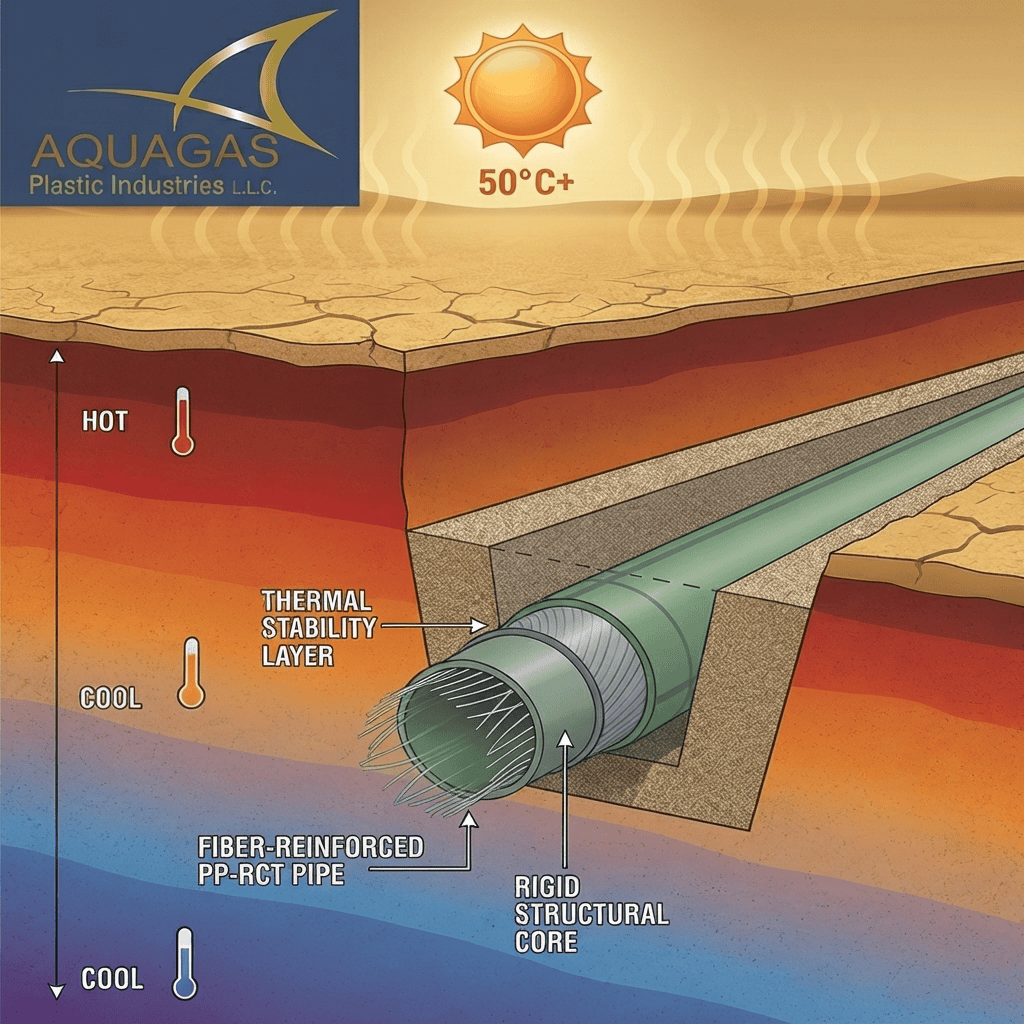
Glass-Fiber Reinforced PP-RCT composite pipes solve this structural vulnerability by altering the physical behavior of the polymer matrix itself. This is achieved through an advanced manufacturing process known as multi-layer co-extrusion, which creates an integrated three-layer pipe wall structure.
PP-RCT Composite Wall Structure:
[Outer Layer: PP-RCT] ─── [Middle Layer: Glass-Fiber + PP-RCT Compound] ─── [Inner Layer: PP-RCT]
The Inner and Outer Layers (PP-RCT Performance)
The inner and outer layers are composed of premium Polypropylene Random Crystallinity Temperature (PP-RCT) resin. Unlike standard PPR, our PPRCT pipe range undergoes a specialized beta-nucleation process during production. This creates a dense, highly crystalline molecular structure.
This crystalline modification allows the material to maintain exceptional long-term hydrostatic strength at elevated temperatures (70°C and above) with significantly thinner walls, enabling higher flow rates and reducing total material weight, the same performance profile that makes it a natural fit for centralized solar water heating loops where consistent high-temperature output is non-negotiable.
The Middle Layer (The Structural Backbone)
The middle layer is where thermal expansion is defeated. It consists of a customized compound of glass fibers blended directly with PP-RCT resin. During the co-extrusion process, these high-tensile glass fibers are structurally aligned along the longitudinal axis of the pipe.
When hot water flows through the system, the glass fibers act as an internal mechanical restraint. They absorb the axial thermal stresses and prevent the polyolefin chains from stretching or expanding lengthwise. Our AquaTerra multilayer range applies this same fiber-stabilized construction across both hot water and chilled water distribution systems.
The Structural Result
By embedding this fiber-core structural layer, the coefficient of linear thermal expansion is slashed by up to 75% compared to standard unreinforced polymer options. The composite pipe exhibits a thermal expansion behavior that closely matches metallic alternatives like copper or stainless steel, while retaining all the lightweight, corrosion-free benefits of a premium polymer system To protect mechanical shafts from the destructive stresses of unmitigated expansion loops, design teams can Specify Advanced Glass-Fiber Reinforced PP-RCT Piping Systems engineered specifically for hyper-arid climates.
.
3. Value Engineering: Slashing Installation Costs and Optimizing Shaft Space
In the competitive UAE real estate market, value engineering is a core priority for project management teams and quantity surveyors. Implementing glass-fiber reinforced PP-RCT pipes delivers immediate financial and structural advantages during the construction phase.
Eliminating Complex Expansion Loops and Bends
Because standard plastic pipes expand dramatically, mechanical engineers are forced to design complex networks of expansion loops, U-bends, and flexible arms into the piping layout. These configurations require a large number of PPR fittings and pipes, increase the number of required structural joints, and demand extensive manual labor on site.
By switching to fiber-reinforced PP-RCT, the 75% reduction in expansion allows contractors to eliminate the majority of these bulky expansion loops. The pipeline can be installed in clean, straight, aesthetic runs with minimal offsets.
| Piping Material Attribute | Standard Unreinforced PPR | Glass-Fiber Reinforced PP-RCT | Impact on UAE Projects |
| Expansion Coefficient | ~0.15 mm/m·K | ~0.035 mm/m·K | 75% reduction in movement |
| Expansion Loops Required | High frequency | Minimal to none | Saves physical space and fittings |
| Support Bracket Spacing | Close intervals (High cost) | Extended intervals (Low cost) | Reduces anchor hardware by ~30% |
| Internal Flow Diameter | Restricted (Thick walls) | Maximized (Thin-wall tech) | Allows pipe downsizing options |
Reducing Support Hanger and Bracket Material Costs
Because unreinforced plastic pipes soften and sag when carrying 65°C water, they require support hangers placed at very close intervals along every meter of the run.
The structural rigidity of fiber-core PP-RCT means the pipe can support its own weight exceptionally well, even at high operating temperatures. This allows installation teams to extend the spacing between horizontal support hangers and vertical pipe clamps. Spacing out these supports reduces the total volume of anchor hardware, threaded rods, and metal brackets by approximately 30%, lowering procurement costs and speeding up on-site installation schedules.
4. Compliance and Longevity: Meeting Strict UAE Green Building Codes
The regulatory environment across the UAE demands that modern infrastructure prioritize environmental sustainability alongside mechanical safety. Large-scale developments must align with green building frameworks like the Dubai Municipality’s Al Sa’fat rating system and Abu Dhabi’s Estidama Pearl Rating System. High-integrity PP-RCT systems are engineered to meet these strict compliance metrics, a certification path detailed further in our overview of specifying PPRCT for government procurement standards.
Reducing Pump Energy Consumption and Friction Loss
The mirror-smooth internal surface of PP-RCT pipes features a hydraulic roughness factor (ε) of just 0.007 mm. This prevents the accumulation of scale, calcium carbonate deposits, or internal biofilm the same mineral-scaling resistance that makes inert polymer piping the preferred choice wherever mineral-rich water supply is a long-term concern.
Because the interior remains perfectly smooth throughout its service life, the system maintains minimal friction loss. This allows building booster pumps to operate with less resistance, reducing daily electricity usage and helping facility managers meet municipal energy-efficiency targets.
Complete Corrosion Resistance Against Treated Water
Domestic hot water loops in premium UAE properties often handle highly treated water that can contain residual chlorine derivatives used for sanitization. These chemical agents cause aggressive pitting corrosion and embrittlement in traditional steel or copper components.
Being an inert hydrocarbon, PP-RCT is entirely immune to electrochemical corrosion. It does not rust, leach chemicals into the potable water supply, or degrade under constant exposure to hot, chlorinated water loops, ensuring an operating lifespan that comfortably exceeds 50 years, in line with the same international benchmarks DVGW (Germany) and WRAS (UK) referenced across our certified PPR pipe range for the Iraqi market.
Frequently Asked Questions (FAQs)
- Why do centralized domestic hot water (DHW) loops in the UAE operate under continuous high thermal loads?
To comply with public health mandates and ensure safety against biological hazards like Legionella bacteria, UAE commercial buildings maintain constant hot water circulation loops. These systems run continuously at temperatures ranging between 60°C and 70°C, which is the exact range at which Legionella bacteria cannot survive.
- What physical infrastructure damage does uncontrolled linear thermal expansion cause in standard polymer pipes?
When standard unreinforced polymer pipes expand significantly within confined spaces, concrete shafts, or dropped ceilings, the excess material causes the lines to bow and sag. This sagging creates low points that disrupt balancing valves and compromise hydraulic efficiency. In vertical risers, it exerts massive mechanical strain on clamps and anchors, potentially ripping them out of concrete walls while concentrating dangerous axial stress at directional changes (elbows, tees, and transition joints), which leads to fatigue cracks and catastrophic system blowouts. Our detailed breakdown on managing thermal expansion in PPR and multilayer systems covers the full range of mitigation techniques.
- How does the multi-layer co-extrusion process and beta-nucleation in PP-RCT defeat thermal expansion?
The pipe wall is manufactured through multi-layer co-extrusion to form a three-layer structure where the inner and outer layers are composed of premium PP-RCT resin that undergoes a specialized beta-nucleation process to create a dense, highly crystalline molecular structure for long-term hydrostatic strength. The middle layer consists of a customized compound of high-tensile glass fibers blended with PP-RCT resin and structurally aligned along the longitudinal axis. These glass fibers act as an internal mechanical restraint that absorbs axial thermal stresses, preventing the polyolefin chains from stretching lengthwise.
- By how much does the glass-fiber core reduce linear thermal expansion compared to standard unreinforced PPR?
By embedding the fiber-core structural middle layer, the coefficient of linear thermal expansion is slashed by up to 75% compared to standard unreinforced polymer options. The expansion coefficient drops from ~0.15 mm/m·K down to ~0.035 mm/m·K, allowing the composite pipe to exhibit a thermal expansion behavior that closely matches metallic alternatives like copper or stainless steel.
- What are the value engineering advantages of using glass-fiber reinforced PP-RCT pipes regarding project costs and site labor?
- Eliminating Expansion Loops: The 75% reduction in movement allows contractors to eliminate the majority of bulky expansion loops and U-bends, permitting clean, straight pipeline runs that save physical space and reduce extra fittings.
- Reducing Hanger Costs: Because the structural rigidity of the fiber-core resists sagging even at high operating temperatures, installation teams can extend the spacing between support hangers and vertical clamps, reducing total anchor hardware, threaded rods, and metal brackets by approximately 30%.
- Pipe Downsizing: Thinner structural walls maximize the internal flow diameter, which allows option routes for downsizing pipe dimensions without sacrificing flow.
- How do premium PP-RCT systems comply with UAE Green Building Codes like Al Sa’fat and Estidama?
- Energy Efficiency: The mirror-smooth internal surface features a hydraulic roughness factor (ε) of just 0.007 mm that prevents scale, calcium carbonate, or biofilm accumulation. This minimizes friction loss, allowing booster pumps to operate with less resistance and reduced daily electricity usage, helping hit municipal energy targets.
- Corrosion Resistance: Being an inert hydrocarbon, PP-RCT is entirely immune to electrochemical corrosion. It does not rust, leach chemicals into the potable water supply, or degrade under constant exposure to hot, chlorinated water loops, ensuring an operating lifespan exceeding 50 years, verified against the same government procurement compliance standards applied across our regional projects.
For technical submittals, engineering data sheets, or project-specific pricing on Glass-Fiber Reinforced PP-RCT systems, connect with the Aquagas Plastics UAE market team directly.
Conclusion: Setting a New Standard for UAE Mechanical Infrastructure
As the UAE continues to lead global real estate innovation with mega-projects that demand maximum engineering efficiency, relying on outdated plumbing materials is no longer viable. Managing high-temperature centralized hot water loops requires a solution that addresses structural stress and thermal expansion without adding unnecessary complexity to the building’s core layout.
Glass-Fiber Reinforced PP-RCT piping systems provide the ultimate combination of thermal stability, mechanical strength, and hydraulic efficiency. By controlling linear expansion at the molecular level, these advanced composite systems protect buildings from hidden leaks, lower structural installation costs, and optimize service shaft space. For UAE consultants, contractors, and developers aiming to deliver sustainable, long-term infrastructure, specifying fiber-core PP-RCT from Aquagas Plastics is a definitive step forward.