Across Baghdad, Basra, and the southern governorates, decades-old galvanized iron and PVC plumbing networks are reaching, or have already passed, the end of their realistic service life. The challenge for engineers, developers, and government procurement teams replacing these systems is not just installing new pipe; it is installing pipe that will not repeat the same failure pattern under Iraq’s specific water conditions: high salinity, high mineral content, and infrastructure that has to function despite inconsistent treatment and supply reliability. This article looks at why GI and PVC have struggled in Iraqi conditions specifically, and why PPR pipe addresses the root causes rather than just delaying the same problems.
The Specific Water Quality Challenge in Iraq
Iraq’s water quality picture is shaped by its two major rivers, the Tigris and Euphrates, both of which carry increasing salinity as they travel south. Research on salinity levels along these rivers has found total dissolved solids increasing by a factor of roughly four along the Euphrates and by a factor of roughly six along the Tigris between their upper and lower reaches.
The situation is most extreme in the south. Reported salinity levels in the Shatt al-Arab have reached between 25,000 and 40,000 TDS across significant stretches of the river, levels comparable to seawater, against a World Health Organization maximum safe drinking water threshold of 500 TDS. While treatment plants work to bring this down to safe levels for distribution, water authorities in Basra continue routine testing for TDS, including the specific ions that contribute to it, such as sodium, chloride, magnesium, and sulfate, alongside hardness and alkalinity.
For PPRCT piping materials, this matters because even treated municipal water in many parts of Iraq carries a higher mineral and ion load than water authorities in lower-salinity regions would consider typical, and this mineral load interacts differently with different pipe materials over time.
Why GI Pipe Fails Faster in Iraq’s Water Conditions
Galvanized iron (GI) pipe has been a mainstay of Iraqi plumbing infrastructure for decades, much of it installed during periods when alternative materials were less available or more expensive. The fundamental issue with GI in high-mineral, high-salinity water is corrosion, specifically, the zinc coating that protects the steel pipe beneath it degrades faster when exposed to water with elevated chloride and sulfate content.
Once the zinc coating is compromised, the underlying steel begins to corrode directly, leading to the classic GI pipe failure pattern: reduced internal diameter from rust and scale buildup, eventual pinhole leaks, and discoloration of water at the tap. This pattern is consistent with broader observations of Iraq’s water network, where the deteriorated and corroded condition of pipe infrastructure, particularly in Baghdad and the south, increases the risk of contamination as groundwater levels rise.
The typical service life of GI pipe under these conditions is commonly cited at 10-20 years, a figure that in practice often comes in lower in southern Iraq’s most saline water conditions, meaning buildings and networks installed with GI face replacement well within a single generation.
Why Standard PVC Falls Short for Iraq’s Hot Water and High-Temperature Needs
PVC addressed the corrosion problem that plagued GI, since PVC does not rust or scale. But PVC introduces a different limitation that is particularly relevant in Iraq: temperature tolerance.
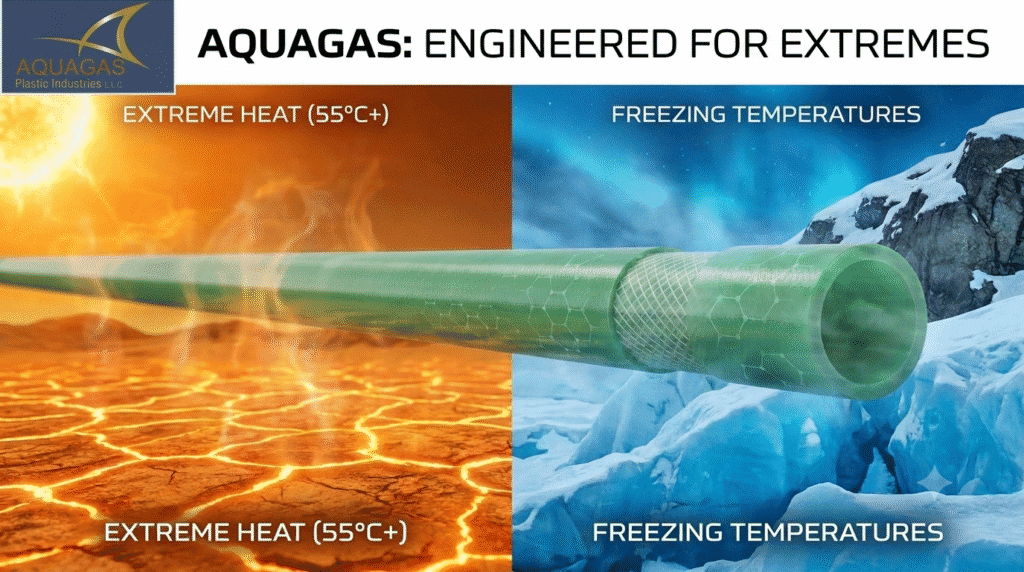
Iraqi summers regularly push ambient temperatures above 50°C in Basra, Baghdad, and the southern governorates. Standard PVC begins to soften and lose pressure-bearing capacity well below this range when carrying hot water, and even cold water PVC lines exposed to direct sun in Iraq’s climate experience accelerated UV degradation and embrittlement over time.
This means PVC’s practical role in Iraqi plumbing has largely been limited to cold water distribution and drainage, leaving hot water systems, heating circuits, and boiler connections to rely on materials, often GI, that bring the corrosion problems described above.
How PPR Addresses Both Problems Simultaneously
PPR (polypropylene random copolymer) pipe is chemically inert, meaning it does not corrode, scale, or react with the dissolved minerals and salts present in Iraqi municipal water, regardless of TDS levels. This directly addresses the GI corrosion problem at its root, rather than slowing it down with a different coating or material.
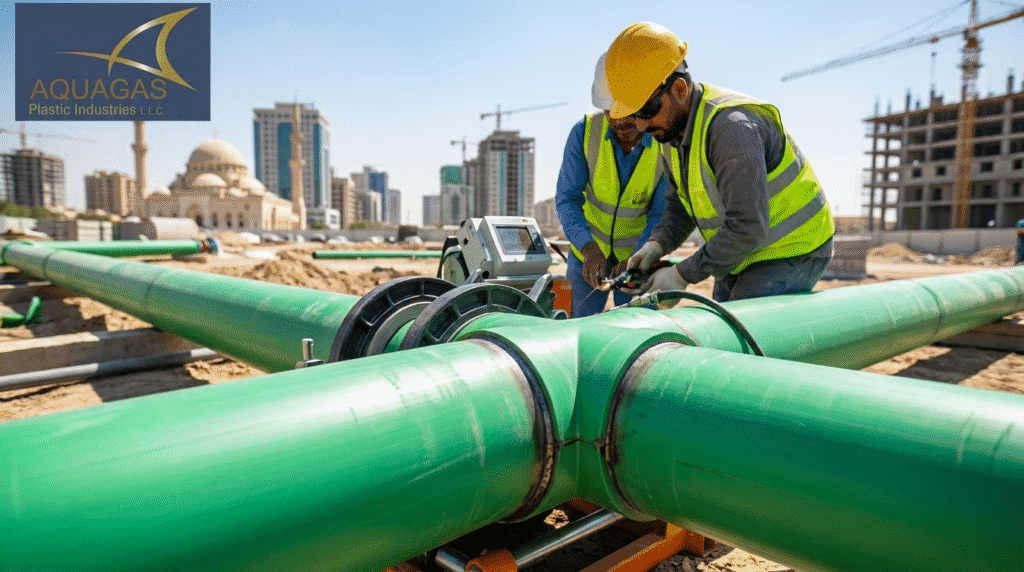
At the same time, PPR piping standards, rated for continuous operation up to 95°C, handles both hot and cold water distribution in a single material system, addressing the temperature limitation that restricts PVC to cold water and drainage applications. PPR pipes supplied in Iraq are manufactured to be suitable for hot and cold-water application networks, plumbing and heating systems, chilled water applications, and radiator and boiler connections, covering the full range of applications that previously required splitting between GI and PVC.
Material Comparison for Iraqi Conditions
| Factor | GI Pipe | Standard PVC | PPR Pipe |
| Performance in high-TDS/saline water | Corrodes, zinc coating degrades, and pinhole leaks | Unaffected (chemically inert) | Unaffected (chemically inert) |
| Hot water suitability | Yes, but corrosion accelerates with heat | Not suitable for temperatures above moderate temperatures | Rated to 95°C continuous |
| UV/heat resistance for exposed runs | Moderate, but corrodes from the inside regardless | Degrades and embrittles under prolonged sun exposure | Engineered for high solar radiation environments |
| Typical service life in Iraqi conditions | 10-20 years, often less in southern governorates | 25-40 years for cold water/drainage applications | 50 years independently verified |
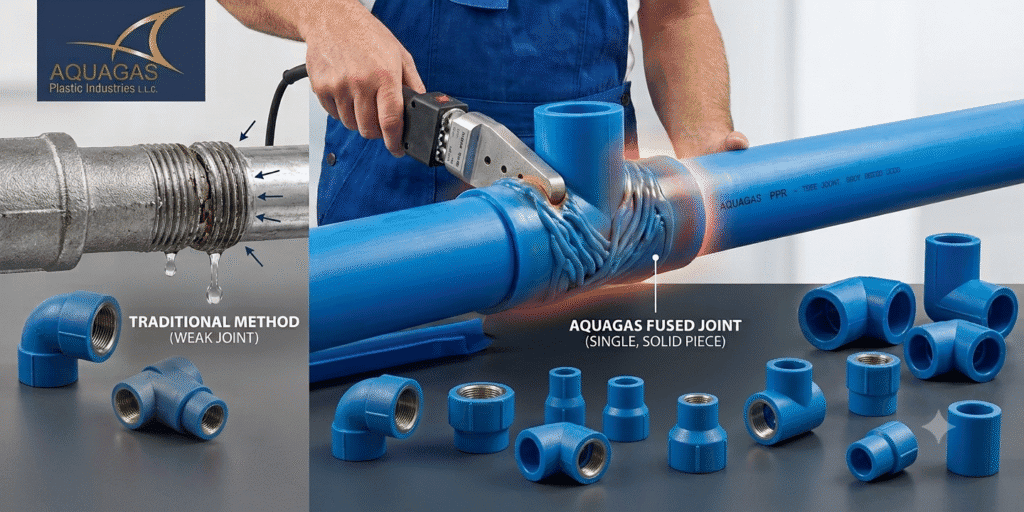
| Joint method | Threaded | Solvent cement | Heat fusion welding |
| Suitable for a single-material hot and cold system | No | No | Yes |
Why This Matters for Iraq’s Reconstruction and New Development Projects
Iraq’s construction sector, spanning government infrastructure programs, residential towers, hospitals, and commercial developments across Baghdad, Basra, Erbil, Mosul, Najaf, and Kirkuk, faces a specific economic argument for material selection: every system installed with materials that fail within 10-20 years under local water conditions represents a future replacement cost and disruption that compounds across a portfolio of buildings.
For government project engineers and procurement teams specifically, the documentation trail matters as much as the material performance. PPR pipe compliance with DIN 8077, DIN 8078, and EN ISO 15874, along with NSF 14, NSF 61, DVGW, SKZ, TÜV, and WRAS certifications, provides the test reports and compliance certificates needed for project approval processes and government tender requirements, a level of documentation that GI and standard PVC installations historically have not carried in the same standardized form.
To streamline your submittal process and secure approved materials, you can Request Aquagas PPR Pipe Certifications for Tenders directly from our engineering team.
Frequently Asked Questions
Can PPR pipe be installed as a direct replacement for existing GI pipe runs in Iraqi buildings?
Yes, PPR pipe is commonly specified as a replacement during renovation or reconstruction projects where existing GI pipework has reached the end of its service life. Transition fittings are used where PPR connects to existing metal components, such as valves or fixtures that are being retained.
Does PPR pipe require any special treatment for Iraq’s high-salinity water before installation?
No. PPR pipe’s chemical inertness means it does not require any pre-treatment or coating to handle high-TDS or saline water. The material composition itself, rather than any applied coating, is what provides resistance to the dissolved minerals and salts present in Iraqi municipal water.
How does the PPR pipe perform during Iraq’s extreme summer heat above 50°C?
PPR pipe fitting formulations supplied for Iraqi conditions are designed for long-term structural integrity across Iraq’s extreme seasonal temperature cycles, from summer highs above 50°C to winter lows in northern Iraq, without the softening or deformation that affects standard PVC at elevated ambient and water temperatures.
Is PPR pipe more expensive than GI pipe for large government infrastructure projects?
Initial material costs vary by project scale and sourcing, but the comparison that matters for government infrastructure is lifecycle cost. Aquagas PPR pipe’s 50-year independently verified service life compared to GI’s typical 10-20 year service life in Iraqi conditions means fewer replacement cycles, less disruption to operational facilities such as hospitals, and lower cumulative procurement and labor costs over a building’s lifetime.
What certifications should be requested when specifying PPR pipe for Iraqi government tenders?
At minimum, documentation should include compliance with DIN 8077, DIN 8078, and EN ISO 15874 for dimensions and material requirements, along with NSF 14 and NSF 61 for potable water safety, and independent verification from bodies such as DVGW, SKZ, or TÜV. These certifications are typically available as test reports and material datasheets for project approval submissions.
Are PPR pipes available with reliable supply and technical support across all major Iraqi cities?
PPR pipes are supplied with project-level technical support across Baghdad, Basra, Erbil, Mosul, Najaf, and Kirkuk, with logistics coordination designed for Iraq’s major construction centers and government project locations.
Final Thoughts
The failure pattern that has defined GI and PVC pipework in much of Iraq, corrosion accelerated by high-salinity water on one hand, and temperature limitations restricting hot water applications on the other, is not a problem that better installation practices or maintenance schedules can fully solve, because it is rooted in the materials themselves reacting to Iraq’s specific water chemistry and climate. PPR pipe addresses both root causes directly: chemical inertness against Iraq’s high-TDS water, and a 95°C continuous temperature rating that covers both hot and cold water in a single certified system.
For Iraqi projects evaluating pipe material specifications for new construction or replacement of aging GI and PVC networks, Aquagas PPR pipes provide full DIN, NSF, DVGW, SKZ, TÜV, and WRAS certification documentation for project approval and government tender processes.