Solar water heating and underfloor heating systems place unique demands on piping components that standard domestic water lines never experience: sustained high temperatures, constant thermal cycling, and in the case of underfloor systems, joints that are sealed inside concrete slabs where any future repair is effectively impossible. This article looks specifically at how PPR fittings perform in these two applications, what design and specification considerations matter most, and why fitting selection for these systems deserves more attention than it typically gets.
Why Solar and Underfloor Systems Are Different from Standard Plumbing
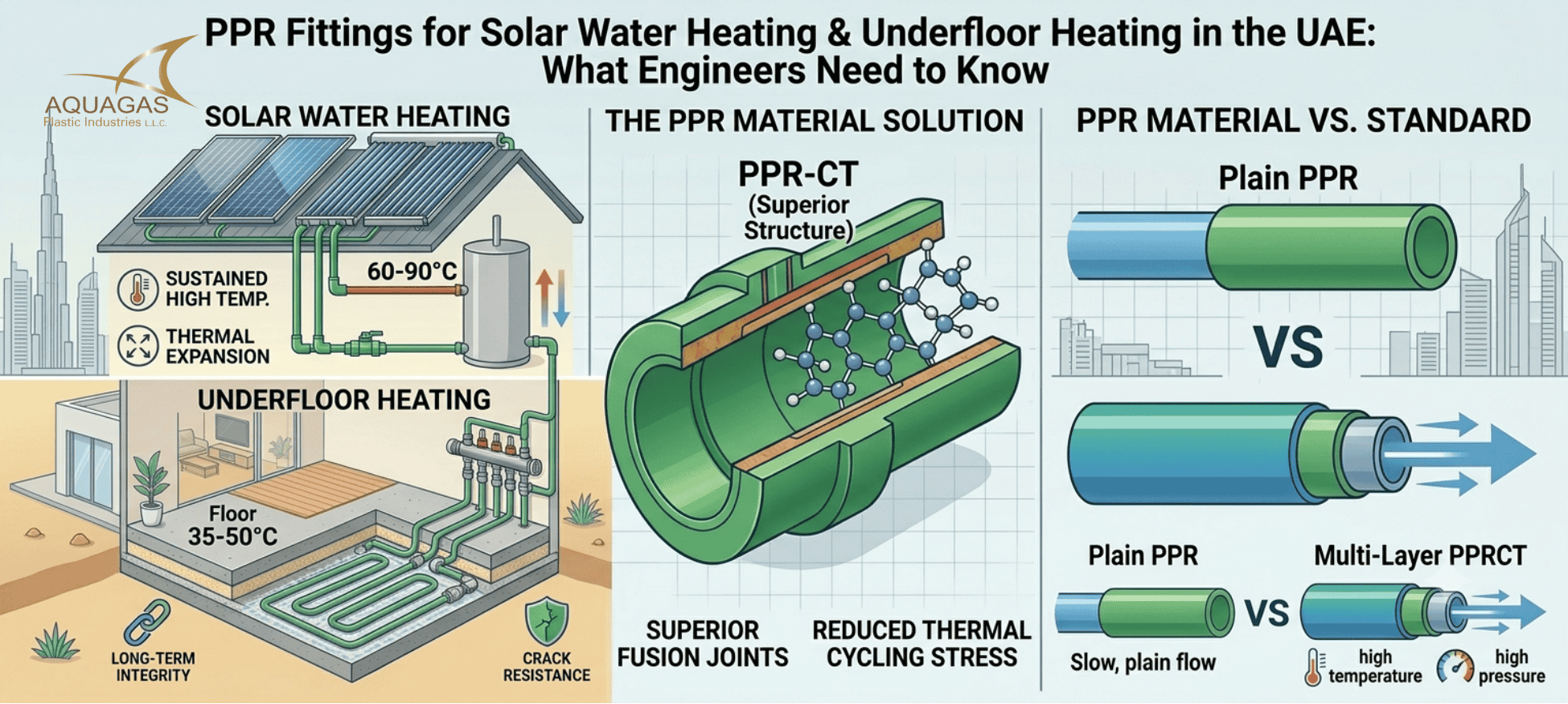
A typical domestic hot water line in a UAE villa might reach 60-70°C during use and sit at ambient temperature the rest of the time. Solar water heating systems and underfloor heating loops operate very differently.
Solar thermal collectors can produce water temperatures well above standard domestic hot water levels, particularly during stagnation periods when the system is not actively drawing water but the collector continues absorbing solar energy. Underfloor heating systems, while operating at lower temperatures than solar collectors, run continuously for extended periods and experience daily on/off thermal cycling as the heating system responds to temperature setpoints.
Both scenarios mean the fittings in these systems experience more frequent and more extreme thermal cycling than a typical domestic supply line, which makes joint integrity and material consistency more critical than in standard applications.
PPR fittings rated for continuous service up to 95°C are specifically positioned for these higher-demand applications, but the rating alone does not address every consideration in system design.
Solar Water Heating Systems: Fitting Considerations
Stagnation Temperature Tolerance
The most important design consideration for solar thermal piping is not the normal operating temperature, it is the stagnation temperature. When a solar collector is exposed to full sun but the system is not circulating water (during a pump failure, for example, or simply when storage tanks are full and demand is low), collector temperatures can rise significantly above normal operating levels for extended periods.
Fittings used in the collector loop need to maintain their structural integrity not just at typical operating temperatures but during these stagnation events, which is why PPR’s continuous 95°C rating, combined with its resistance to UV and thermal aging, makes it suitable for collector loop ppr piping in a way that lower-temperature-rated plastics would not be.
Manifold Headers for Multi-Collector Arrays
Larger solar installations, common on UAE commercial buildings, hotels, and large residential developments, often use multiple collector panels feeding into a shared distribution system. Manifold header fittings allow a single supply and return line to be distributed across multiple parallel collector circuits, which is standard practice for these multi-collector arrays.
The advantage of using PPR manifolds in this context is that the entire collector loop, from individual panel connections through the manifold to the storage tank, can be built from a single compatible material system, avoiding the transition fittings and potential galvanic corrosion issues that arise when mixing metal and plastic components in a high-temperature loop.
Rooftop Exposure and UV Resistance
Solar collector piping is, by definition, installed in direct sunlight on UAE rooftops, often the most thermally demanding location on any building. Fittings in this environment face the combination of high fluid temperature from within and high ambient and surface temperature from solar exposure, along with constant UV radiation.
This is precisely the environment where the difference between certified, UV-stabilized PPR fittings and lower-quality alternatives becomes most apparent over time. A fitting that performs adequately in a shaded indoor plant room may degrade significantly faster when subjected to years of direct UAE rooftop sun exposure.
Underfloor Heating Systems: Fitting Considerations
The “No Second Chances” Reality of Embedded Joints
Underfloor heating pipe loops are typically embedded within a screed or concrete layer, meaning that once the floor is finished, the piping system is physically inaccessible without breaking up the floor. This changes the calculus for fitting selection entirely.
In a standard exposed plumbing run, a PPR fitting joint that develops a slow leak years later can be identified, accessed, and repaired with relatively contained disruption. In an embedded underfloor system, the same failure means demolition of flooring, a cost and disruption magnitude that is dramatically higher.
For this reason, underfloor heating installations place a premium on joint reliability that is even higher than standard plumbing, since the cost of a failure is not just the repair itself but the floor finishes, furniture, and occupied space disruption that comes with accessing an embedded pipe run.
To protect your project from these costly failures, you can Specify High-Temperature PPR Fittings designed for embedded installation.
Manifold Distribution for Zone Control
Underfloor heating systems are typically designed as multiple parallel loops, one or more per room or zone, all connecting back to a central manifold. This manifold is usually the only point in the system that remains accessible after installation, housed in a manifold cabinet rather than embedded in the floor.
PPR manifold header fittings used at this distribution point allow each zone loop to be isolated, balanced, or serviced independently, which is important for both initial commissioning and any future adjustments to the system’s flow balancing.
Thermal Cycling and Long-Term Fatigue
Underfloor heating systems cycle on and off daily, sometimes multiple times per day depending on the control strategy. Each cycle involves the pipe and any embedded fittings expanding as they heat and contracting as they cool. Over a 20-30 year building lifecycle, this represents tens of thousands of thermal cycles.
While PPR’s thermal expansion characteristics are well documented and accounted for in standard pipe runs through expansion loops and fixing points, embedded systems do not have the same flexibility for expansion accommodation. This makes the quality and consistency of any fittings used within or near the embedded loop, even just at transition points to the manifold, particularly important, since these are the points where repeated cycling stress concentrates over the system’s lifetime.
Comparing Fitting Requirements: Solar vs Underfloor vs Standard Domestic
| Factor | Standard Domestic Hot Water | Solar Water Heating | Underfloor Heating |
| Typical operating temperature | 50-70°C | Up to and beyond 95°C during stagnation | 30-50°C, continuous cycling |
| Exposure to UV | Limited, mostly indoor | High, rooftop installation | None, embedded |
| Accessibility for repair | Generally accessible | Accessible (rooftop) | Effectively inaccessible once embedded |
| Thermal cycling frequency | Intermittent, demand-based | High during sunny periods | Continuous, multiple cycles per day |
| Manifold usage | Less common | Common for multi-collector arrays | Standard for zone distribution |
| Criticality of joint reliability | Important | High due to stagnation extremes | Highest due to inaccessibility |
Specification Recommendations for Engineers and Consultants
For solar thermal collector loops, specify Mutilayer PPR fittings with documented continuous temperature ratings that account for stagnation scenarios, and ensure manifold headers are sized correctly for the number of collector circuits in the array.
For underfloor heating manifolds and any accessible fitting points in embedded systems, prioritize certified fittings from manufacturers who can provide consistent dimensional documentation, since these are the points where any future serviceability of the system depends entirely on fitting quality and joint integrity established at the time of installation.
In both applications, full technical datasheets and certification documentation should be requested and retained as part of the project handover package, both for warranty purposes and for any future facilities management reference.
Frequently Asked Questions
Can the same PPR fittings be used for both solar water heating and standard domestic hot water lines?
In many cases yes, provided the fittings carry a continuous temperature rating sufficient for solar stagnation scenarios. However, the design considerations, particularly UV exposure on rooftop solar runs and stagnation temperature tolerance, mean fitting selection should be reviewed specifically for the solar application rather than assumed to be identical to standard domestic specification.
Why are manifold headers used in underfloor heating systems instead of individual connections to each loop?
Manifolds allow each heating zone or loop to be connected to a common supply and return at a single accessible point, which simplifies installation, enables individual zone balancing and isolation, and keeps the only serviceable connection points outside the embedded floor area.
What happens if a fitting fails inside an embedded underfloor heating loop?
Repair typically requires locating the failure point, often through pressure testing and thermal imaging, and then breaking out the floor finish and screed at that location to access and repair the pipe section. This is a significant and costly intervention, which is why fitting quality and installation technique are emphasized so heavily for these systems before the floor is finished.
Does solar collector stagnation actually reach temperatures that affect PPR fittings?
Stagnation temperatures depend on collector type, orientation, and system design, but they can exceed normal operating temperatures significantly during periods of no circulation under full sun. This is precisely why continuous high-temperature rating, rather than just the typical operating temperature, is the relevant specification criterion for collector loop fittings.
Are PPR manifolds compatible with both solar and underfloor heating applications?
Yes, PPR manifold header fittings are used in both contexts, though sized and configured differently depending on whether they are distributing flow across solar collector circuits or underfloor heating zone loops. The underlying fitting technology, heat-fused PPR construction, is the same across both applications.
Should fittings in solar and underfloor systems be certified to a higher standard than standard domestic fittings?
The fittings themselves are typically the same certified product line, manufactured to DIN and EN ISO 15874 standards. What changes is the importance of verifying that certification and selecting fittings with appropriate continuous temperature ratings, since the consequences of a failure in these systems, particularly underfloor, are significantly more severe than in standard exposed domestic plumbing.
Final Thoughts
Solar water heating and underfloor heating systems push PPR fittings into more demanding thermal conditions than standard domestic plumbing, whether through stagnation temperatures on exposed rooftop solar loops or through the simple fact that underfloor fittings, once embedded, cannot be accessed without major disruption. For UAE projects incorporating either system, fitting specification deserves the same level of attention as the pipe itself, with continuous temperature ratings, UV resistance, and full certification documentation reviewed specifically for the application rather than assumed from standard domestic specifications.
For technical datasheets, manifold configurations, and certified fitting ranges suitable for solar and underfloor applications, Aquagas Plastics’ PPR fittings range provides the documentation needed for project specification and authority submission.