Kenya’s residential construction boom, particularly the proliferation of gated communities and multi-unit estates around Nairobi’s expanding suburbs like Syokimau, Ruaka, and Athi River, as well as similar developments in Mombasa, Nakuru, and other growing towns, has created a specific plumbing design challenge that single-unit villas don’t face: how to distribute water supply efficiently and serviceably across dozens or hundreds of individual units from a shared supply source. Manifold header fittings are central to solving this, and how they’re specified affects everything from initial installation cost to how easily issues get resolved years later. This article looks at the role of manifold distribution in Kenya’s estate-style developments and what developers and MEP contractors should consider when specifying these systems.
What a Manifold Header Actually Does
A manifold header is a multi-outlet fitting that takes a single supply (and return, where applicable) line and distributes it across multiple parallel circuits. In a residential estate context, this typically means a manifold takes the main water supply for a block or cluster of units and distributes it to each individual unit’s connection point, or within a unit, distributes from the unit’s main connection to each bathroom and kitchen zone.
Manifold header fittings are described as widely utilized in solar heating circuits and high-rise riser distribution throughout Kenya’s hospitality sector, and the same distribution logic applies directly to gated communities and multi-unit estates, where the “multiple circuits” are individual units rather than solar collectors or floors.
Why Estate-Scale Developments Need to Think About Distribution Architecture Early
In a single villa, water distribution is relatively simple: one main connection, branching to the various fixtures within that one home. In an estate with dozens of units sharing infrastructure, water distribution becomes a network design question, how does supply reach each unit, how is each unit’s consumption isolated for billing and maintenance, and what happens when one unit needs a repair without affecting its neighbors.
A manifold-based distribution architecture answers these questions by creating defined distribution points, manifolds, at the levels where the network branches: from the estate’s main supply to each block or cluster, and from each block’s supply to individual units. This creates a structured, traceable network rather than an ad-hoc arrangement of branch connections that becomes increasingly difficult to understand and maintain as the development grows.
Isolation and Maintenance: The Practical Argument for Manifold Architecture
The most immediate practical benefit of manifold-based flow distribution in a multi-unit development is isolation. When each unit (or each zone within a unit) connects through a manifold outlet, that specific outlet can typically be isolated, often through an integrated or adjacent valve, without affecting supply to other units on the same manifold.
This matters enormously in an estate context. Without this architecture, isolating one unit for a repair, a leak, a fixture replacement, or a renovation, might require shutting off supply to a larger section of the network, affecting units that have nothing to do with the issue being addressed. For property managers and body corporates running Kenyan estates, where tenant relations and minimizing disruption matter for property reputation and tenant retention, this isolation capability is a direct operational benefit, not just a technical nicety.
PPR Ball Valves at Manifold Points: Corrosion-Free Isolation
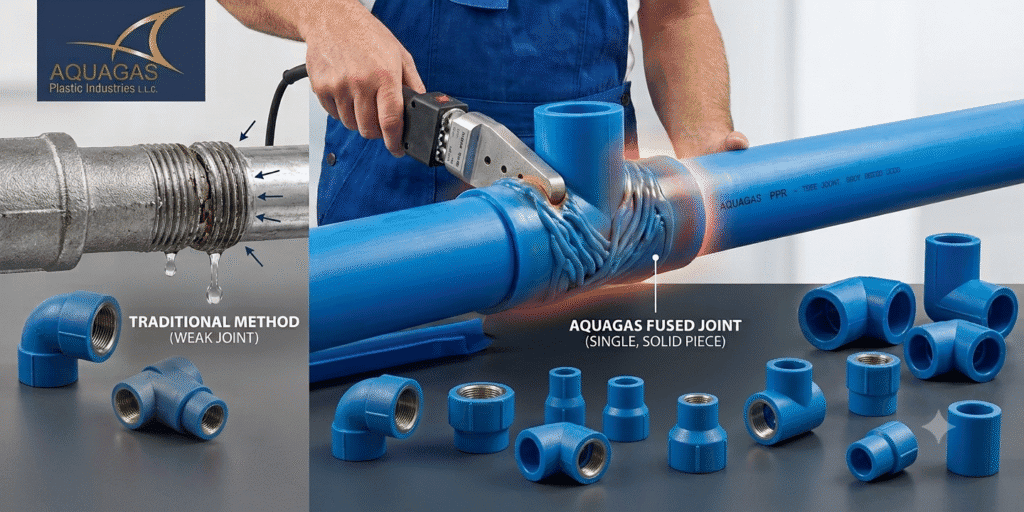
PPR ball valves, described as full-bore valves heat-fused directly into the line, providing leak-free zone isolation that is fully rust-proof unlike traditional brass valves, are particularly relevant at manifold isolation points in estate developments.
Brass valves, the traditional choice for isolation points in plumbing systems, are vulnerable to the same mineral-related degradation that affects other metal components in Kenya’s borehole and mineral-rich municipal water conditions. A valve that becomes difficult to operate, or develops a slow leak around its stem or seals due to mineral buildup over years of service, undermines the exact isolation capability the manifold architecture was designed to provide. A heat-fused PPR ball valve, integrated into the same corrosion-free material system as the rest of the pipework, removes this degradation pathway from the isolation points that the estate’s maintenance operations depend on.
To ensure leak-free zone containment across your distribution headers without the risk of seized handles, you can Specify Full-Bore PPR Ball Valves engineered for high-mineral groundwater lines.
Union Fittings: Serviceability at Connection Points
Union fittings, the three-piece connectors that allow disconnection without cutting the pipe, serve a complementary role to manifolds and ball valves in estate plumbing. Described as essential for water meters, booster pumps, and solar tanks, allowing maintenance without cutting the pipe, unions are particularly relevant at the points where individual unit water meters connect to the shared manifold system.
In an estate where individual unit metering is standard (for billing or consumption monitoring), the meter itself may eventually need replacement, recalibration, or temporary removal for testing. A union fitting at this connection point means the meter can be removed and replaced without requiring the surrounding pipework to be cut and re-fused, a meaningful difference when the alternative means disrupting a section of pipework that serves a live, occupied unit.
Manifold Distribution Architecture for a Typical Kenyan Estate
| Distribution Level | Typical Fitting Configuration | Purpose |
| The estate’s main supply to the block/cluster | Primary manifold or distribution main with isolation valves per block | Allows whole-block isolation for major maintenance without affecting other blocks |
| Block supply to individual units | Manifold header with one outlet per unit, ball valve per outlet | Per-unit isolation for repairs, renovations, or non-payment without affecting neighbors |
| Unit’s main connection to internal zones | Internal manifold distributing to bathroom/kitchen zones, often with a union at the meter | Per-zone isolation within the unit, serviceable metering connection |
Why This Matters for NCA-Registered Projects and Procurement
For Kenyan developers working on NCA-registered projects, where PPR fittings are specified as the first-choice option for Kenyan MEP contractors, manifold-based distribution architecture using certified, matched components, manifolds, ball valves, unions, and standard fittings all from the same heat-fusion-compatible system, simplifies both the initial procurement (a single coherent system rather than mixing material types at different network levels) and the long-term facilities management of the completed estate.
Frequently Asked Questions
How many units can a single manifold header serve in an estate development?
This depends on the manifold’s outlet count and the pressure and flow requirements of the units it serves, which should be calculated as part of the development’s hydraulic design. Manifold headers are available in various configurations, and the specific sizing for a given estate’s block sizes and unit counts is a design decision made by the project’s MEP consultant based on the overall water demand calculation.
Does a manifold-based distribution cost more than a simpler branch distribution?
Manifold architecture may involve a different initial material cost compared to a simpler branch network, but the practical benefits, easier isolation, clearer fault-finding, and simplified future maintenance generally represent a cost trade-off that favors manifold architecture for any development beyond a handful of units, where the operational benefits of isolation and traceability outweigh any difference in initial material specification.
Can PPR ball valves be serviced or replaced if they eventually need it?
PPR ball valves are heat-fused into the line as part of the permanent pipework, similar to other PPR fittings. If a valve itself ever needs replacement, this would typically involve cutting out and re-fusing that section, which is why unions are often specified at points (like meters) where more frequent access is anticipated, while ball valves at manifold isolation points are expected to function for the system’s full service life without requiring replacement.
How does manifold distribution affect water pressure across different units in an estate?
Manifold distribution itself doesn’t inherently change overall pressure availability; that’s determined by the supply source, pumping (if applicable), and overall pipe sizing. What manifold architecture provides is a defined, traceable distribution structure; pressure balancing across units is a separate hydraulic design consideration that the MEP consultant addresses through appropriate PPRCT pipe sizing at each distribution level.
Are manifold systems only relevant for new estate developments, or can they be retrofitted?
Manifold-based distribution is most straightforward to implement during new construction, since it involves a defined network architecture from the outset. Retrofitting an existing development with manifold distribution would involve more significant rework of the existing pipework, though sections of an existing system can sometimes be reorganized around manifold points during major renovation phases, depending on the existing infrastructure’s layout.
Where can developers and MEP contractors in Kenya source manifold headers and matched PPR fittings for estate projects?
Manifold header fittings and the full range of matched PPR fittings, including ball valves and unions, are available through Aquagas Plastic Industry authorized distributors across Nairobi, Mombasa, Nakuru, and Kisumu, with DIN, NSF, and EN ISO 15874 certification documentation for project specification.
Final Thoughts
As Kenya’s gated community and estate development model continues to expand around Nairobi and other growing urban centers, the plumbing distribution architecture within these developments has practical consequences that extend well beyond the construction phase, affecting how easily issues get isolated and resolved for years of occupancy. Manifold-based distribution, using certified PPR manifolds, ball valves, and unions as a coherent matched system, provides the structured isolation and serviceability that multi-unit developments need, while corrosion-free PPR construction ensures these isolation points remain functional across Kenya’s mineral-rich water conditions for the system’s full service life.
For estate and gated community projects across Kenya, Aquagas’s PPR fittings range provides the manifolds, valves, and matched components for well-architected multi-unit water distribution.