The reconstruction and expansion of Iraq’s urban centers stand as critical priorities for national development. With the Iraqi government embarking on ambitious initiatives to build 21 new cities and close a gap of three million housing units, the resilience of utility networks is under intense scrutiny. Among these utilities, municipal water distribution systems face the most severe operational hurdles.
In major urban hubs like Baghdad and Basra, water infrastructure must contend with aggressive chemical compositions, extreme environmental conditions, and historical network degradation. Traditional piping materials, such as galvanized iron, carbon steel, and ductile iron, have consistently failed to provide long-term reliability, succumbing to rapid internal and external corrosion. To secure the future of Iraq’s water infrastructure, municipal planning and modern construction methodologies are shifting toward advanced polymer solutions. Polypropylene Random Copolymer (PPR) piping systems present a highly durable, corrosion-free alternative capable of engineering out the systemic water quality and structural failures that have historically challenged Baghdad and Basra. Aquagas Plastics has been supplying certified piping systems built specifically for these conditions, part of a wider shift documented in Iraq’s ongoing construction boom driving a new piping standard nationwide.
1. The Geographic and Chemical Profile of Iraq’s Water Crisis
To understand why traditional piping materials fail prematurely in Iraq, one must analyze the distinct chemical and environmental factors affecting the country’s two largest metropolitan regions.
Baghdad: High Turbidity, Fluctuating pH, and Industrial Runoff
As the capital city expands, its water distribution system relies heavily on the Tigris River. The raw water entering Baghdad’s treatment complexes exhibits significant seasonal variations:
- High Turbidity and Sedimentation: Heavy silt loads during flood seasons cause severe mechanical abrasion inside metallic pipes, stripping away protective localized oxide layers.
- Corrosive Chemical Injections: To combat high microbial counts and turbidity, municipal water treatment facilities utilize aggressive chlorination and heavy doses of aluminum sulfate (alum) as a coagulant. Residual chlorine in the water stream forms hypochlorous acid, a powerful oxidizing agent that rapidly accelerates the pitting corrosion of metallic conduits.
- Fluctuating pH Levels: Industrial runoff and urban wastewater discharges alter the water’s chemical balance, causing frequent shifts in pH that destabilize standard metallic piping networks.
Basra: Hyper-Salinity, Total Dissolved Solids (TDS), and Marine Intrusion
Located at the tail end of the Tigris and Euphrates rivers, the southern Basra governorate faces an even more hostile fluid environment. Depleted river flows from upstream sources have allowed a dense marine saltwater tide from the Arabian Gulf to intrude far inland up the Shatt al-Arab river. Independent reporting on Basra’s water crisis has documented how this saline intrusion has left residents without reliable access to safe drinking water for years.
- Extreme Salinity and TDS: Total Dissolved Solids (TDS) levels in Basra’s raw water supply regularly exceed thousands of parts per million (ppm), transforming the municipal water grid into a highly conductive electrolyte.
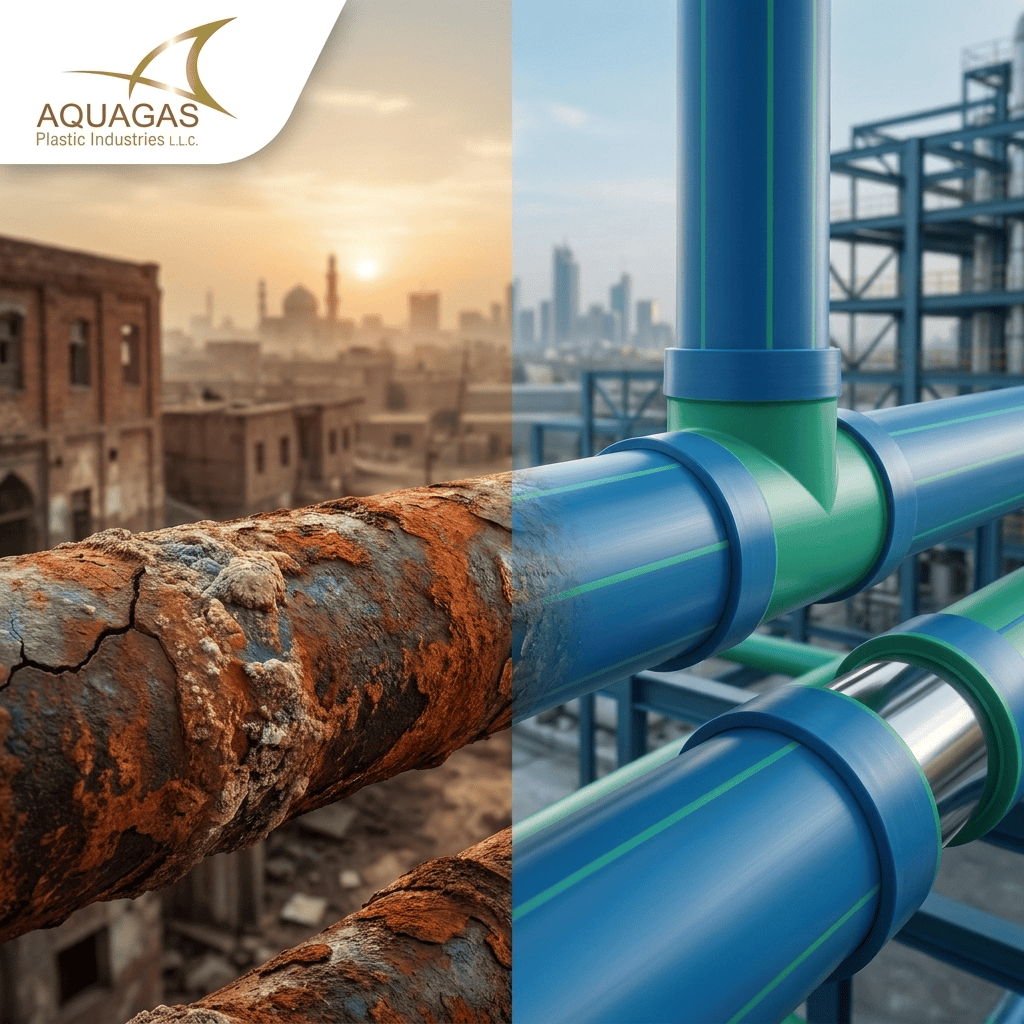
- Galvanic and Pitting Corrosion: This hyper-saline fluid causes near-instantaneous galvanic and pitting corrosion in iron and steel pipes.
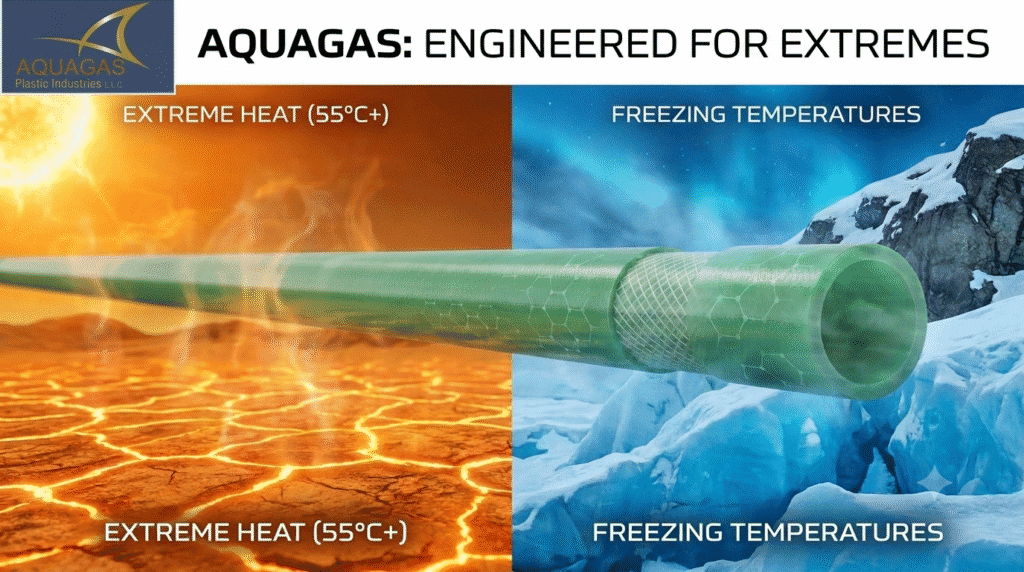
- High Ambient and Fluid Temperatures: Ground temperatures in southern Iraq routinely surpass 50°C during summer months. Elevated temperatures act as a catalyst, exponentially accelerating the chemical kinetics of metallic oxidation and scale deposition.
2. The Failure Modes of Traditional Metallic Piping
The historical reliance on metallic networks in Baghdad and Basra has resulted in severe infrastructural vulnerabilities, driven by three primary failure modes.
Internal Tubercular Corrosion and Flow Reduction
When metallic pipes contact oxygenated, high-TDS water, iron oxides accumulate on the pipe’s inner walls. This process, known as tuberculation, creates rough, irregular nodules. These formations restrict the internal diameter of the pipe, drastically reducing hydraulic flow rates and increasing friction losses. Consequently, municipal pumping stations must consume significantly more energy to push water through the restricted network.
Biofilm Accumulation and Water Contamination
The rough, pitted surfaces of corroded metal pipes serve as ideal breeding grounds for complex bacterial biofilms. These biofilms shield pathogenic microorganisms from residual chlorine disinfectants. In Basra and Baghdad, where secondary sewage cross-contamination occurs due to structural cracks in adjacent wastewater networks, metallic corrosion directly compromises public health by rendering treated water unsafe by the time it reaches residential taps.
Structural Weakening and High Leakage Rates
Pitting corrosion eventually penetrates the full wall thickness of metallic pipes, leading to widespread micro-fractures and catastrophic pipe bursts. Non-revenue water (NRW) losses, water lost to the ground before reaching consumers, frequently exceed 40% in older Iraqi networks. Threaded metallic joints are the most common failure point, which is why utility contractors are replacing them with fusion-welded PPR fittings that eliminate the leak path a pattern already well established in Iraq’s oil and industrial sector, where process water and chemical handling demand the same corrosion-free jointing. This high rate of failure leads to constant pressure drops, frequent service disruptions, and costly, reactive emergency maintenance cycles.
3. Engineering Advantages of PPR Piping Systems
Polypropylene Random Copolymer (PPR) represents a major advancement in material science for civil infrastructure. It addresses the precise chemical and mechanical weaknesses that cause metallic infrastructure to fail. All Aquagas Plastics Iraq piping systems are manufactured to meet ISO 15874 requirements for hot and cold water installations.
+————————————————————————+
| PPR MATERIAL ARCHITECTURE |
| |
| [Polypropylene Backbone] — (Random Ethylene Insertion) |
| │ |
| ▼ |
| Structural Flexural Strength |
| + High Chemical Inertness |
| + Smooth Internal Substrate (Roughness ≈ 0) |
+————————————————————————+
Absolute Chemical Inertness and Corrosion Resistance
PPR is a non-polar hydrocarbon polymer. Unlike metals, it does not conduct electricity and cannot participate in electrochemical redox (reduction-oxidation) reactions. Whether exposed to the hyper-saline, high-chloride waters of Basra or the heavily chlorinated, variable-pH streams of Baghdad, PPR pipes remain completely unaffected by oxidation. They experience zero rust, zero pitting, and zero structural degradation over their entire operational lifecycle.To isolate public distribution mains from chemical oxidation and aggressive electrolytic attack, municipal engineering teams can Specify Certified Corrosion-Free PPR Piping Systems built to withstand extreme water conditions.
Exceptional Hydraulic Efficiency
The internal substrate of a PPR pipe is exceptionally smooth, boasting a surface roughness factor ($e$) approaching zero. This smooth profile delivers distinct engineering benefits:
- Elimination of Scale Build-up: Calcium carbonate and other minerals present in hard water cannot adhere to the ultra-smooth polymer wall, preventing scale accumulation and maintaining a constant internal diameter.
- Lower Friction Losses: A low friction coefficient minimizes pressure drops across long distribution lines, allowing municipal engineering teams to optimize pumping systems and reduce long-term energy consumption.
For high-rise distribution, pump-fed networks, and industrial process lines running at sustained high temperatures, engineers increasingly specify PPRCT pipes. The enhanced crystalline structure gives PPRCT a higher continuous temperature rating and stronger pressure resistance than standard PPR, which matters in Basra’s solar heating and central hot water systems. The same reliability requirement is covered in depth for solar water heating applications across Iraq, where grid reliability cannot be assumed.
Homogeneous Structural Integrity via Fusion Welding
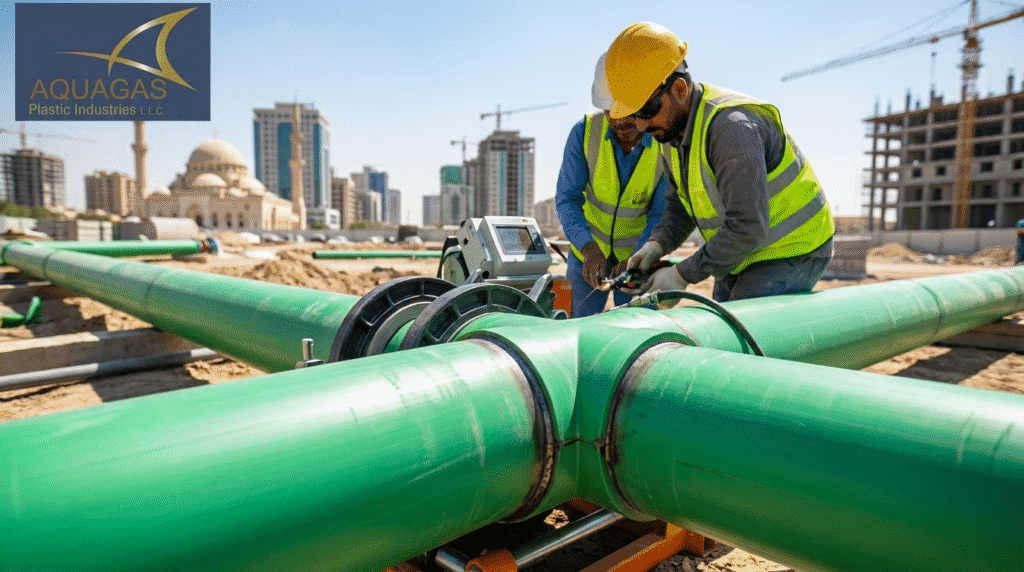
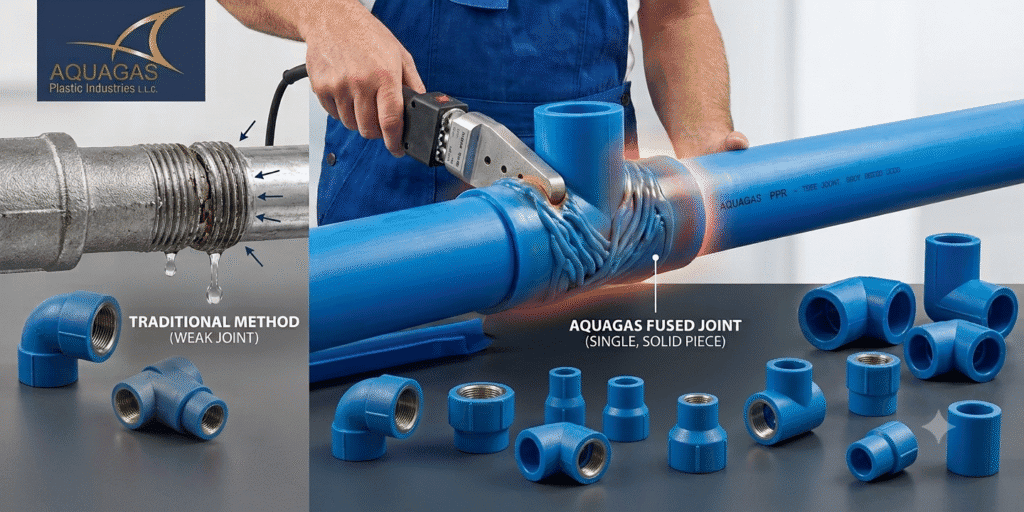
One of the weakest points of any piping network is its joint connections. Metallic systems rely on mechanical threading, flanging, or rubber gaskets, which degrade over time. PPR systems utilize heat fusion welding (socket or butt fusion), melting the pipe and fitting interfaces together at temperatures around 260°C. Matched PPR fittings, elbows, tees, reducers, and ball valves ensure the whole network expands and contracts uniformly.
This process creates a joint that is materially identical to the pipe body itself, creating a continuous, leak-proof system that easily withstands high-pressure surges and ground shifts.
4. Deploying PPR in Modern Iraqi Infrastructure
To maximize the benefits of PPR systems in large-scale projects throughout Baghdad, Basra, and Iraq’s newly planned cities, specific engineering best practices must be implemented during design and installation.
1. Thermal Expansion Management
PPR has a higher coefficient of thermal expansion than metallic alternatives. In environments like Iraq, where ambient temperatures fluctuate drastically between day and night, and summer and winter, lines must be engineered to accommodate physical movement. Designers utilize strategically placed expansion loops, offset joints, and specialized anchoring guides to absorb thermal variations without putting stress on connections, following the same engineering approach outlined for managing thermal expansion in PPR and multilayer piping systems effectively under extreme regional heat.
2. Multi-Layer Fiber-Composite PPR Co-Extrusion
For high-temperature applications or long structural runs, advanced multi-layer PPR pipes (such as PPR-FG, reinforced with an integrated middle layer of fiberglass) are highly recommended. The fiberglass core reduces linear thermal expansion by up to 75% compared to standard PPR, increases structural rigidity, and provides higher pressure resistance at elevated temperatures. Systems built on the AquaTerra platform are engineered specifically to this brief for chilled water and high-rise distribution networks.
3. Comprehensive UV Stabilization
Extended exposure to solar ultraviolet (UV) radiation can degrade unprotected polyolefins, causing material embrittlement over time. For above-ground installations across Iraq, PPR pipes must feature integrated carbon black or specific hindered amine light stabilizers (HALS). Alternatively, lines can be shielded within protective conduits or coated with UV-resistant insulation jackets. A complementary PP Terra drainage system, manufactured from flame-retardant polypropylene, is commonly paired with the supply-side network to give a unified, leak-free plumbing and drainage solution.
5. Economic and Strategic Impact on Sustainable Growth
Transitioning Iraq’s municipal utility networks to PPR piping offers compelling economic benefits alongside its clear technical advantages.
| Evaluation Metric | Traditional Metallic Piping (Iron/Steel) | Advanced PPR Piping Systems |
| Material Longevity | 10–15 Years (highly variable due to corrosion) | 50+ Years (highly stable asset lifecycle) |
| Maintenance Profile | Intensive, reactive emergency leak repairs | Negligible, preventative system checks |
| Installation Efficiency | Heavy machinery required; slow welding/threading | Lightweight handling; rapid heat fusion jointing |
| Pumping Efficiency | Decreases over time due to internal scaling | Remains constant due to smooth internal walls |
The extended operational lifespan of PPR radically transforms project economics. A service life exceeding 50 years directly reduces the capital expenditure lifecycle costs borne by regional water directorates. Furthermore, because PPR components are lightweight, they simplify logistics, transport, and site handling. The rapid speed of heat fusion joints minimizes installation windows, allowing contractors to complete urban rehabilitation projects ahead of schedule and with minimal disruption to traffic and local commerce. For government and NGO-funded tenders that require a higher-grade material classification, PPRCT pipes deliver the same 50-year lifecycle backed by documented international certification, precisely the procurement standard detailed in guidance on specifying PPRCT for government tenders in Iraq.
Frequently Asked Questions (FAQs)
- Why do traditional metallic pipes fail prematurely in Baghdad’s municipal water network?
Baghdad’s raw water from the Tigris River exhibits heavy silt loads that cause severe mechanical abrasion inside metallic pipes. Furthermore, municipal treatment facilities utilize aggressive chlorination and heavy alum doses, resulting in residual chlorine that forms hypochlorous acid, a powerful oxidizing agent that rapidly accelerates pitting corrosion. Frequent shifts in pH due to industrial runoff and wastewater further destabilize these metallic networks. - What specific fluid challenges does Basra’s water infrastructure face, and how does PPR overcome them?
Basra faces a highly hostile fluid environment where marine saltwater intrusion up the Shatt al-Arab river drives Total Dissolved Solids (TDS) levels to thousands of ppm, transforming the municipal grid into a conductive electrolyte that causes near-instantaneous galvanic and pitting corrosion in steel and iron. Additionally, high ground temperatures catalyze metallic oxidation. PPRCT, being a non-polar hydrocarbon polymer, cannot conduct electricity or participate in electrochemical redox reactions, experiencing zero rust or structural degradation in these conditions. - How do the failure modes of metallic piping directly impact public health and municipal energy costs in Iraq?
Internal tubercular corrosion creates rough iron oxide nodules that restrict fluid flow and increase friction losses, forcing municipal pumping stations to consume significantly more energy. Public health is directly compromised because these rough, pitted surfaces serve as breeding grounds for complex bacterial biofilms that shield pathogens from residual chlorine disinfectants, failing to protect against sewage cross-contamination. - What mechanical advantages does heat fusion welding provide for Iraq’s infrastructure projects?
Unlike metallic systems that rely on mechanical threading, flanging, or rubber gaskets that degrade over time, PPR fittings utilize heat fusion welding at approximately 260°C. This process melts the pipe and fitting interfaces together to create a single continuous homogeneous structure that is materially identical to the pipe body. This creates a continuous, leak-proof system capable of withstanding high-pressure surges and ground shifts. - How should engineers manage thermal expansion and UV exposure when deploying PPR in Iraq?
To manage the drastic ambient temperature fluctuations in Iraq, designers utilize strategically placed expansion loops, offset joints, and anchoring guides. For high-temperature applications, advanced multi-layer fiber-composite PPR pipes (PPR-FG) are recommended to reduce linear thermal expansion by up to 75%. For above-ground layouts, pipes must feature integrated carbon black or hindered amine light stabilizers (HALS), or be shielded within protective conduits or insulation jackets to prevent UV embrittlement. - What are the long-term economic benefits of transitioning from metallic piping to advanced PPR systems in Iraq’s new cities?
While traditional metallic piping offers a highly variable material longevity of only 10–15 years due to corrosion, advanced PPR systems provide a highly stable asset lifecycle of 50+ years, radically reducing capital expenditure lifecycle costs. Furthermore, PPR requires negligible preventative maintenance compared to intensive, reactive emergency leak repairs, and its lightweight composition speeds up installation windows while minimizing urban disruptions.
Conclusion: Securing Iraq’s Water Future
The ongoing infrastructure development in Baghdad and the comprehensive revitalization of Basra demand engineering choices that solve long-standing environmental challenges. Designing water grids with materials vulnerable to corrosion is no longer viable. Specifying advanced polymer solutions like PPR pipes allows engineers to directly address the issues of high salinity, aggressive chemical treatments, and structural degradation.
Adopting corrosion-free, hydraulically efficient, and reliably leak-proof PPR piping networks represents a vital step forward. This technology safeguards public health, optimizes water retention, and ensures that Iraq’s massive investment in new urban centers yields resilient, sustainable utility grids for generations to come.
Engineers and contractors sourcing certified piping systems for projects in Baghdad, Basra, or elsewhere in the country can review the full Aquagas Plastics product range, or browse the complete portfolio at aquagasplastics.com for specifications covering every market Aquagas Plastics serves.