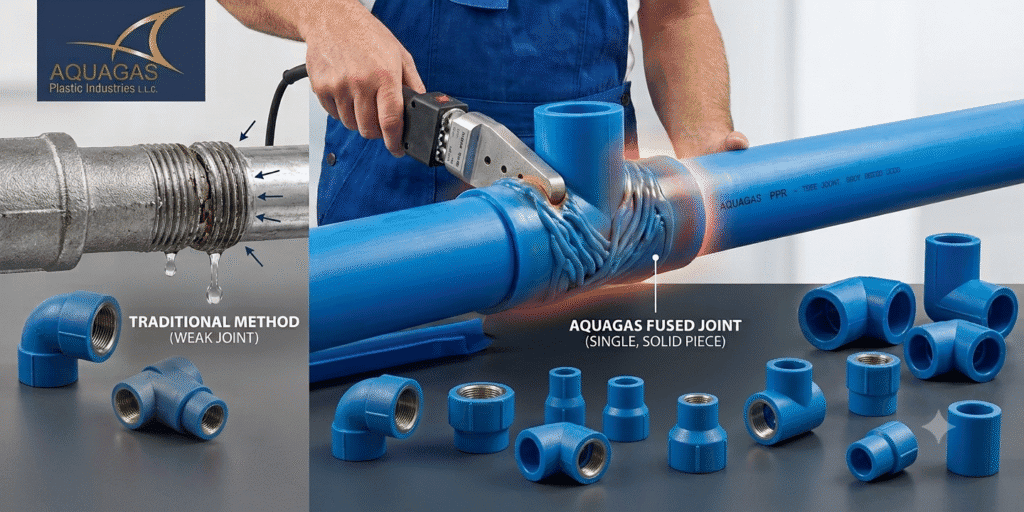
Iraq’s building stock spans decades of construction, and a huge proportion of existing residential, commercial, and government buildings still carry galvanized steel pipework, valves, and fixtures installed long before PPR became the standard specification. When these buildings are renovated, extended, or have sections replaced, the new PPR system rarely starts from zero. It has to connect to what is already there: existing metal valves, pumps, boilers, and taps that are staying in place. This is the specific job of threaded adapter fittings, and getting this transition right is often the difference between a renovation that performs reliably and one that introduces a new weak point exactly where the old and new systems meet.
Why Transition Points Are the Highest-Risk Part of Any Retrofit
In a brand-new PPR installation, every joint in the system is the same material, joined the same way, heat fusion welding, creating molecularly bonded connections with no mechanical interfaces to fail. A retrofit project is different. Somewhere in the system, the PPR pipe has to connect to something that is not PPR: a galvanized steel riser that is being retained, an existing brass valve, a boiler inlet, or a pump connection that uses standard threaded fittings.
This transition point is mechanically different from the rest of the system. It relies on a threaded connection rather than a fused one, which means it depends on correct thread engagement, appropriate sealing compound or tape, and torque applied correctly, factors that do not apply anywhere else in a PPR system. For PPR fittings supplied in Iraq, male and female threaded adapters are specifically engineered to make this single mechanical transition point as reliable as possible.
Male Threaded Adapters (MTA): Connecting PPR to Existing Female-Threaded Components
A male threaded adapter has a PPR socket end on one side, which is heat-fused to the PPR pipe in the normal way, and an externally threaded (male) connection on the other side, designed to thread into existing internally threaded (female) components.
In practice, this is the fitting used when new PPR pipeworks needs to connect into an existing component that has a female threaded port: a brass gate valve being retained from the old system, an internally threaded inlet on a water heater, or a connection point on existing pump equipment. The PPR side of the joint is fused as normal, giving full heat-fusion reliability right up to the transition point, and only the final connection into the legacy component relies on the threaded interface.
Female Threaded Adapters (FTA): Connecting PPR to Externally Threaded Equipment
The reverse scenario, where the existing component has an external (male) thread, calls for a female-threaded adapter. The FTA has a PPR socket end for fusion to the pipe, and an internally threaded socket on the other end that receives the externally threaded component, a tap, a boiler connection point, or an externally threaded pump outlet.
These two fitting types together cover the two directions a PPR pipe system needs to interface with existing threaded infrastructure, whether that infrastructure is being retained permanently or is itself due for eventual replacement but cannot be swapped out during the current phase of work.
Why This Matters Specifically for Iraq’s Renovation and Phased Construction Projects
Across Baghdad, Basra, and Erbil, a significant volume of construction activity involves renovating, extending, or upgrading existing buildings rather than building entirely new structures. Government housing programs, hospital upgrades, and commercial renovations frequently involve replacing sections of aging galvanized pipework while equipment such as pumps, water heaters, and certain fixtures remain in service, either because full replacement isn’t budgeted for the current phase, or because the equipment itself is still functional and doesn’t need replacing.
In these projects, threaded adapter fittings are not a minor accessory item; they are the components that determine whether the new PPRCT sections integrate cleanly with what remains of the old system, or whether the transition points become the first place a renovated system develops problems.
To ensure a secure, leak-free bridge between legacy metal and modern piping systems, you can Specify Threaded PPR Adapters engineered specifically for high-risk transition zones.
Technique Considerations for Threaded PPR Connections
Unlike heat-fused PPR joints, where the jointing process is largely standardized regardless of who performs it, threaded connections introduce variables that depend on installer technique.
Thread compatibility: Existing Iraqi plumbing infrastructure may use BSP (British Standard Pipe) or NPT (National Pipe Thread) threading, depending on the age and origin of the original installation. Confirming thread type before specifying adapters avoids a mismatch that either won’t seal properly or won’t thread together at all.
Sealing method: PTFE tape or appropriate thread sealant is required on the threaded side of the connection, since the threading itself does not create a watertight seal on its own. The PPR socket side of the adapter does not require any sealant, as that connection is made through heat fusion.
Avoiding over-tightening: Threaded plastic fittings can crack if over-tightened, particularly female threaded adapters where the threads are formed in the polypropylene itself. Hand-tight plus a measured additional turn, rather than maximum torque, is the standard approach.
Supporting the joint during fusion: When fusing the PPR socket side of an MTA or FTA to a pipe, the fitting needs to be supported so that heat and pressure are applied evenly, since these fittings have a different mass distribution than a simple coupling due to the threaded portion.
Threaded Adapter Selection Reference
| Scenario | Fitting Required | PPR Side | Connection Side |
| Connecting to an existing female-threaded valve (e.g., retained brass gate valve) | Male Threaded Adapter (MTA) | Socket, heat-fused to pipe | External (male) thread into valve |
| Connecting to an existing male-threaded tap or boiler outlet | Female Threaded Adapter (FTA) | Socket, heat-fused to pipe | The internal (female) thread receives the component |
| Connecting to a pump inlet with a female port | Male Threaded Adapter (MTA) | Socket, heat-fused to pipe | External (male) thread into the pump |
| Terminating a branch for future fixture connection | Female Threaded Adapter (FTA) | Socket, heat-fused to pipe | Internal thread ready for fixture |
Frequently Asked Questions
Can threaded PPR adapters be used with existing galvanized steel pipe threads directly?
Threaded adapters connect to threaded components such as valves, taps, and equipment ports rather than directly threading onto the cut end of galvanized pipe, since GI pipe ends are not typically threaded for plastic adapter connections in the way fittings and valves are. For connecting directly into a cut section of existing GI pipe, a transition coupling or union designed for mixed-material connections is the more appropriate approach, and should be specified based on the specific pipe ends involved.
Are threaded PPR connections as reliable as heat-fused joints long term?
Heat-fused joints create a permanent molecular bond and are generally considered more reliable long-term than any mechanical or threaded connection, which is why PPR pipe systems in Iraq are designed to minimize the number of threaded connections, using them only where a transition to non-PPR components is unavoidable. Threaded adapters, correctly installed with appropriate sealant, provide a reliable connection, but they remain a different category of joint from the rest of the system and may be a point that requires occasional inspection over the system’s life.
What happens if the wrong thread type (BSP vs NPT) is used for an adapter?
BSP and NPT threads have different profiles and pitch, and while they may appear to engage initially, a mismatched thread type typically will not seal properly and risks damaging the threads on both components if forced. Confirming the thread standard used in the existing installation before ordering adapters avoids this issue.
Can a single PPR system include both MTA and FTA fittings at different points?
Yes, this is common in renovation projects where a single system might connect to a female-threaded valve at one point and a male-threaded tap or boiler connection at another. Each transition point is assessed individually based on the existing component it needs to connect to.
Do threaded PPR adapters affect the pressure rating of the overall system?
The threaded connection itself is rated for the pressure class of the PPR fitting, consistent with the PPR system’s PN rating, provided it is correctly installed with appropriate sealant. The pressure rating of the system as a whole is determined by its weakest point, which is why the correct installation of threaded transitions matters for maintaining the system’s overall pressure integrity.
Where can renovation contractors in Iraq source certified MTA and FTA fittings?
Male and female threaded adapter fittings, along with the full range of certified PPR fittings for Iraqi projects, are available through Aquagas’s distributor network across Baghdad, Erbil, Basra, Mosul, Najaf, and Kirkuk, supplied with DIN, NSF, and WRAS certification documentation.
Final Thoughts
Threaded adapter fittings are small components that solve a specific, recurring problem in Iraq’s renovation-heavy construction landscape: how to bring a modern, certified PPR system into contact with the metal infrastructure that a building has relied on for decades, without that single connection point becoming the weakest link in an otherwise leak-free system. Male and female threaded adapters, correctly specified for the thread type involved and correctly installed with appropriate sealing, allow new PPR pipework to integrate cleanly with existing valves, pumps, and fixtures across Iraq’s renovation and phased construction projects.
For project-specific guidance on threaded adapter selection and the full certified PPR fittings range for Iraq, Aquagas Plastics provides technical support for contractors working across both new construction and renovation projects.