When engineers and developers evaluate PPR pipe for Iraqi residential towers and apartment blocks, the conversation usually centers on the properties that prevent failure: corrosion resistance, pressure rating, and temperature tolerance. These matter enormously, but they address whether the system works. Two other properties, acoustic performance and fire behavior, determine whether the system works well for the people living in the building, day after day, for decades. This article looks at why these two often-overlooked specifications deserve more attention in multi-unit residential projects across Baghdad, Basra, Erbil, and other major Iraqi cities.
The Noise Problem in Multi-Story Residential Plumbing
Anyone who has lived in an apartment with poor plumbing acoustics knows the experience: a neighbor flushes a toilet or runs a shower, and the sound of water rushing through pipes is clearly audible through walls and ceilings, sometimes loud enough to wake people at night.
This is not simply a matter of pipe diameter or water pressure. It is significantly influenced by the pipe material itself. Metal pipes, including GI, transmit vibration and flow noise efficiently along their length and into the structure they are fixed to, because metal is a relatively efficient conductor of mechanical vibration. As water moves through a metal pipe, especially around bends, through valves, or during pressure changes, the resulting vibration travels through the pipe wall and into wall cavities, ceiling voids, and structural elements, re-emerging as audible noise in adjacent rooms or units.
How PPR Pipe Material Properties Affect Acoustic Performance
Polypropylene has fundamentally different vibration-damping characteristics compared to metal. As a polymer, PPR pipe absorbs and dissipates a greater proportion of the flow-induced vibration within the pipe wall itself, rather than transmitting it efficiently into surrounding structures. PPR pipes specified for Iraqi projects are documented with a low-noise rating of 21 decibels at a 4 liter-per-second flow rate, a specification that becomes directly relevant in any building where plumbing runs pass through or adjacent to occupied spaces, which in practice means almost every multi-unit residential building.
For context, a quiet residential interior at night is often in the range of 30-40 decibels of ambient sound. A plumbing system that generates noise in the low 20-decibel range at typical flow rates is operating well below the threshold where it would be perceptible as a disturbance, compared to systems where pipe-transmitted noise can exceed ambient levels and become a noticeable, recurring annoyance.
Why This Matters Specifically for Iraqi Apartment and Residential Tower Projects
Iraq’s residential construction sector includes a significant volume of multi-unit apartment buildings and towers across Baghdad, Basra, and other major cities, often built to accommodate dense urban populations. In these buildings, plumbing risers and branch lines frequently run through or adjacent to shared walls between units, and through ceiling voids above living spaces.
The acoustic performance of the plumbing system Iraq in these conditions is not a luxury specification; it is a quality-of-life factor that residents experience directly, and that affects how a building is perceived over its operational life. A development with audible plumbing noise between units generates ongoing complaints to building management, tenant dissatisfaction, and, in some cases, becomes a factor in unit desirability and resale or rental value, issues that are far more costly to address after construction than they are to specify against at the design stage.
Fire Safety Considerations: Flame-Retardant PPR for Multi-Story Buildings
The second often-overlooked specification is fire behavior. In any multi-story residential building, fire safety regulations typically require that materials used in common areas, risers, and shafts meet specific flame-retardant standards, since these vertical and horizontal distribution routes can become pathways for fire spread between floors and units if not properly addressed.
Flame-retardant PPR pipe options, such as those available in Aquagas’s PPTerra system range, are specifically engineered for these applications. Flame-retardant PPR formulations are designed to resist ignition and limit flame spread compared to standard polypropylene, addressing fire compliance requirements that apply to plumbing risers passing through fire-rated walls, floors, and shafts in multi-story construction.
For Iraqi developers and consultants working on residential towers, hospitals, hotels, and government buildings, where fire safety compliance is both a regulatory requirement and a fundamental life-safety consideration, specifying flame-retardant PPR for riser and shaft applications addresses a compliance requirement that standard pipe specifications may not meet.
To ensure your building design fully meets these vertical shaft safety regulations, you can Specify Low-Noise PPR Pipes featuring certified flame-retardant engineering.
Acoustic and Fire Performance Comparison
| Property | Standard GI Pipe | Standard PVC | Standard PPR | Flame-Retardant PPR (PPTerra) |
| Vibration/noise transmission | Highly efficient conductor of flow noise | Moderate | Low, documented at 21dB @ 4L/s | Low, same acoustic benefit as standard PPR |
| Suitable for riser/shaft fire compliance | Non-combustible (metal) | Generally not flame-retardant | Standard formulation, check project requirements | Engineered for flame retardance |
| Joint type affecting acoustic transmission | Threaded, can loosen and increase noise over time | Solvent cement | Heat fusion, permanent and stable | Heat fusion, permanent and stable |
| Long-term acoustic stability | Can worsen as corrosion affects joints | Stable | Stable | Stable |
Where Acoustic and Fire Specifications Intersect with Project Type
For standalone villas and low-density housing in Iraq, acoustic performance between units is less of a concern simply because there are fewer shared walls and adjacent occupied spaces. Fire compliance for riser systems is also less complex in low-rise structures with simpler escape routes.
For apartment towers, hospitals, hotels, and any multi-story residential or mixed-use development, both factors become directly relevant. Hospitals in particular combine high acoustic sensitivity, patients in recovery need quiet environments, with stringent fire compliance requirements for life-safety systems, making the combination of low-noise and flame-retardant PPR Pipe specifications particularly relevant for healthcare construction projects across Iraq.
Frequently Asked Questions
Does choosing a PPR pipe for noise reduction mean sacrificing pressure rating or temperature performance?
No. The acoustic damping properties of PPR fitting are inherent to the polymer material itself and do not require a trade-off against pressure rating or temperature tolerance. A correctly specified PPR system, whether PN16, PN20, or PN25, retains its acoustic advantages over metal pipe regardless of pressure class.
Is flame-retardant PPR pipe required for every plumbing application in a multi-story building?
Not necessarily for every application, but it is typically specified for risers and pipework passing through fire-rated compartmentation, such as floor slabs and fire-rated walls separating units or compartments. Project-specific fire engineering requirements determine exactly where flame-retardant specifications apply, and this should be confirmed with the project’s fire safety consultant.
Can existing buildings with noisy GI plumbing be retrofitted with PPR to reduce noise?
In renovation projects, replacing GI sections with PPR pipe in Iraq can improve acoustic performance for the replaced sections. However, full acoustic improvement typically requires addressing the entire flow path, since noise can still be transmitted through any remaining metal sections or through structural connections at fixtures and brackets.
How does heat fusion jointing affect long-term acoustic performance compared to threaded joints?
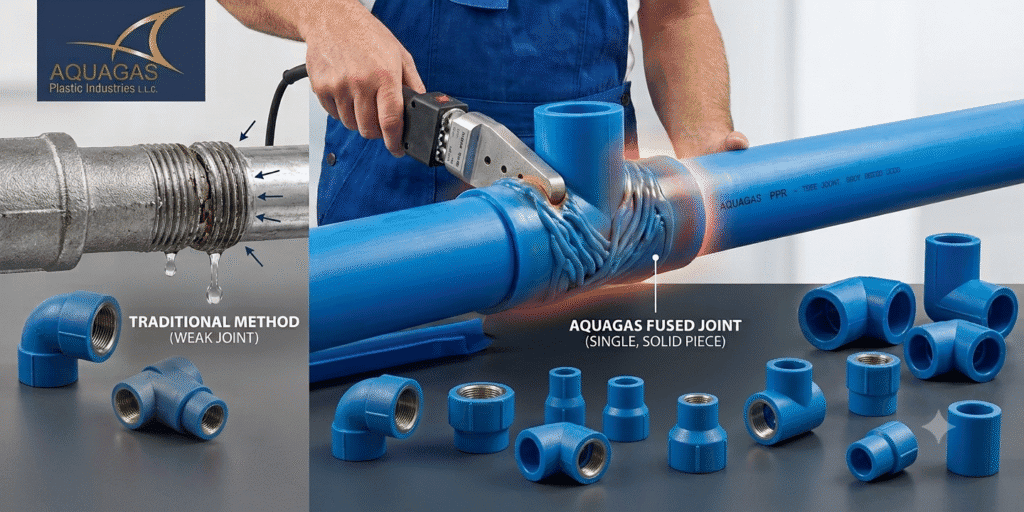
Heat fusion joints in PPR create a permanent, homogeneous connection that does not loosen over time. Threaded joints in metal pipe systems can loosen gradually due to vibration and thermal cycling, which can increase noise transmission and create minor leaks at connection points as the system ages.
Are AquaTerra and PPTerra systems both suitable for Iraq’s climate, or is one specifically for fire-rated applications?
Both AquaTerra and PPTerra systems are designed for Iraq’s high-temperature and variable water quality conditions. PPTerra specifically incorporates flame-retardant properties suited to fire compliance requirements in multi-story and commercial construction, while AquaTerra is positioned for general high-heat and pressure applications. The project specification should match the system to the specific application requirements.
Where can developers get technical documentation on acoustic and fire performance for PPR pipe in Iraq?
Technical datasheets, including the documented 21dB noise rating at 4L/s flow rate and flame-retardant material specifications for the PPTerra range, are available through Aquagas’s PPR pipe documentation for Iraqi projects, alongside the full DIN, NSF, and EN ISO 15874 certification package.
Final Thoughts
Pressure ratings, temperature tolerance, and corrosion resistance determine whether a plumbing system survives. Acoustic performance and fire behavior determine whether the building it serves is comfortable, compliant, and safe to live and work in every day. For Iraq’s growing stock of multi-story residential, hospitality, and healthcare developments, specifying PPR pipe with documented low-noise performance and, where required, flame-retardant formulations addresses considerations that become permanent and largely unfixable once construction is complete.
For technical specifications on acoustic performance and flame-retardant PPR options suited to Iraqi residential and commercial projects, Aquagas Plastics’ PPR pipe range provides full documentation for MEP consultants and developers.